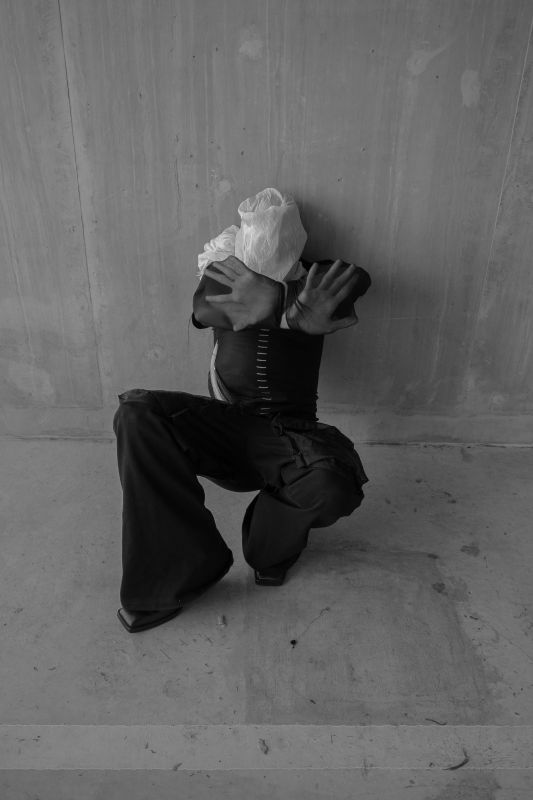
We sat down with Australian designer Larrend Lacuesta to learn more about him and his brand, Neuterlab. We decided to get a better understanding of his design language, what inspires him and more.
Could you quickly introduce yourself, tell us who you are, and what you do.
My name is Larrend Lacuesta. I am based in Greater Brisbane, Australia, originally from the Philippines where I lived for the first 16 years of my life. I’m the founder and co-owner of Neuterlab, a genderless fashion label that explores experimental silhouettes. By day, I work as an HR manager and by night, I build Neuterlab. The brand reflects my creative philosophy and quiet rebellion.
You grew up in the Philippines and spent half your life there, before moving to Australia in your late teens. Did moving to Australia help you express yourself and find your personal style and identity?
It’s impossible to compare what resources a 16-year-old may need VS resources a 28-year-old need (when I started the brand). When I talk about resources, I talk about financial independence, creative freedom, convenience in accessing museums, and the space to explore fashion and my personal style. In the Philippines, I was still too young to start anything, and I didn’t have the means to pursue design seriously. However, “maturing” in Australia gave me the opportunity to build something on my own terms. I would say 50% and 50% how I was influenced by my significant other (Karl Leuterio), who is also the co-owner of Neuterlab! When we started dating in 2013, that’s when I really formed my style DNA and it has stayed consistent up until now, if not evolved slightly. Me and my partner, Karl, gravitate toward monochromatic, androgynous silhouettes with a grunge edge and an undercurrent of elegance (at least that’s how I see it).
What’s the meaning behind the name ‘Neuterlab’?
Neuterlab is a fusion of two ideas: “neuter,” as in neutral, non-binary, stripped of gendered expectations; and “lab,” as in experimentation. It’s a space where clothing isn’t confined by rules, rather expressing freely. The name reflects our ethos: genderless, conceptual, and quietly defiant.
You did not study fashion, how did you end up pursuing fashion design and establishing your own brand, what was the driving force behind your decision?
I never studied fashion formally, but I’ve always been immersed in it emotionally. My creative journey started with photography when I was 16, initially self-portraiture. If you want to see some of my photos, I have a separate Instagram page called @ninthsheep.larrend. For over a decade, I used photography to explore my identity. When I met Karl, I found out he was a fashion designer so I wanted him to make something conceptual for me then to photograph them. Karl is THE professional designer, and I was influenced by him. Eventually, I began sketching what I would like to wear. Mainly clothes with designs I couldn’t find anywhere else. That intuitive process led to Neuterlab. The driving force was, I wanted to create a world I could live in, one that felt true to my values. One that felt permanent because it’s in my control.
Was fashion design something that you’ve always wanted to do, or have you pursued other creative endeavors prior, in order to clench that creative thirst?
Photography and short fashion films were my first creative outlet. I released three self-published magazines called Ninthsheep, featuring nostalgic travel photos, self-portraits and conceptual fashion styling with my partner Karl. That visual storytelling naturally transitioned into fashion design. Neuterlab is an extension of that (or vice versa), it’s a continuation of the same emotional language, just in a different medium.
What are some of the biggest challenges that you’ve faced as someone who didn’t study fashion, but also what type of advantages do you think you’ve had based on past life experiences that you could implement into your business model?
The biggest challenge is technical construction. I don’t know advanced sewing techniques, and I’m limited to making clothes on a domestic sewing machine. I have so many design ideas I want to make, that’s why I work with a manufacturer who can execute my designs and sometimes I work with other Australian creatives to make those ideas come to life. The advantage is curiosity will always drive that passion, whether you studied fashion formally or not. Another advantage is learning in the process. I’ve learned how to respect the work of other Australian designers I’ve collaborated with. In addition to that, I’ve studied business, and my professional background is Human Resources so that gave me a strong commercial mindset. I know how to position the brand, manage (small) operations. For example, draw boundaries when agreement is compromised, etc.
Do you think your outlook on fashion design, and fashion in general, would have been different if you attended fashion school or have you always had a certain distinct style and vision in mind?
I don’t think fashion school would’ve changed my outlook. There is so much educational fashion content on the internet. It is the content that you feed your mind at the end of the day. Fashion is a term that is used broadly. If I may inject the term lifestyle, please. That lifestyle is formed through lived experience, through research, museums, networking, fashion films, music, performance art, behaviour, etc. That lifestyle will never stay stagnant rather it evolves as you keep meeting new people, see a new film, hear new music. One thing is for sure though, that the grassroots of that style DNA (once you know exactly the path to take) will stay strong. The style DNA/ or that vision in my mind has always been (in the last decade) androgynous, monochromatic, experimental, and elegant.
Do you draw inspiration from your Filipino heritage when it comes to your designs?
I would like to say yes, the way my brain is wired and how I behave is rooted from my Filipino upbringing and my exposure to Philippine entertainment. That contributes to how I see the world around me. However, if we’re talking about inspiration that is translated into a visual design then I have to say no. I am saying no with a bit of guilt. It never crossed my mind until this question. I am now curious about exploring Filipino art and fashion subcultures, to honour parts of myself.
Could you describe your research process when it comes to creating your garments and collections.
My process is entirely intuitive. I don’t do traditional research or patternmaking. For example, if I’m watching a film and I see a costume I like, I would sketch that, so I don’t forget. If I go to a museum and see a texture, I start to think which hardware store product would closely resemble this texture. If I see someone wearing something cool, I will digest the components of their outfit and envision what silhouette would work on me if I were to wear something similar. To me everything is reinventing. I remember sewing some of my one-off pieces design, I would just start cutting fabrics and sew them based on my vision alone. No markings, no measurements. Just instinct.
Who, or what, are some of the/have been some of the key inspirations in your journey as a creative, as a designer, or in life in general? Is there someone that you’ve looked up to specifically when it comes to fashion design or fashion in general?
Rick Owens’ ceremonial styling, Ann Demeulmeester’s editorial photos, Margiela’s runway show casting, The Row’s furniture and jewellery curation and Patti Smith poetic eloquence. The two who I specifically look up to are Rick Owens and Patti Smith. Rick Owens on his philosophy to learn how to make clothes, work and work and produce and produce to reveal your identity. Patti Smith, because of her uniformity with the clothes she wears and artistic spirit (specially after reading her books) which inspires me to age with grace and imagination. Moreover, Patti Smith for me is a key influence, I feel she is the best link we have to many other artists like Rob Mapplethorpe, Andy Warhol, Lou Reed, etc
Neuterlab also does art-pieces, can you elaborate on the idea and the vision behind it? Is it something that you’ve chosen to do based on previous experiences or is it part of the brand’s world building?
For our November 2023 Collection Launch (the collection has no name by the way), I created framed art pieces to extend the mood of the collection. They emphasize texture, rabbit fur, wires, leather strings, scarred cowhide leather, sharp pins. I have chosen to do this not based on previous experience rather part of the brand’s world building. The art pieces were not enclosed in a sealed container. I wanted it intentionally left uncovered so people who attended the launch event could touch them. It was about creating tactile experience, where part of the clothes can be framed and co-exist as framed art and wearable art. The framed artworks weren’t separate from the garment. They were their echo.
What type of world is the Neuterlab brand trying to build, and what type of message is it trying to convey?
Neuterlab is building a world where clothing is emotional, and self-expression is sacred. You wear it and you instantly embrace your uniqueness. It is a quiet rebellion. One that invites introspection.
On your website, it states that the Neuterlab brand tries to invent new cultures and new aesthetics. Can you tell us more about this approach and what would the end result be once these visions have, in your opinion, been completed?
We’re not trying to fit into mainstream fashion cultures. That means inventing aesthetics that feel personal to me. The end result isn’t a finished product. I see it as a living archive. A slow evolution of my style, my philosophy and emotional clarity. A vision that becomes tangible and will exist even long after I’m gone is something remarkable. So, there will be no end result until my last breath I suppose. To me it will forever be a personal project I share with the world.
You are the second Australian designer that we’ve spoken to, what is your opinion on the Australian fashion industry, and what do you think it can learn from the rest of the world? But also what do you think the rest of the world could learn from Australia?
I think the Australian fashion industry hasn’t yet made a defining mark globally. That said, Australians dress very nicely, especially with their stature, they clearly carry themselves well. I just wish more people were brave enough to dress differently even if they are not attending an event. Regarding what I think it can learn from the rest of the world is to try something different, something that makes you curious and open. What the world can learn from the Australian Fashion industry is… I don’t have an opinion.