We sat down with Slovenian designer duo Urška & Tomaž Draž, at the lobby café of Allegro Hotel in Ljubljana, just across the street from their studio, to explore their unique approach to knitwear, their design process and how their design philosophy has evolved in over three decades of work at Draž Studio.
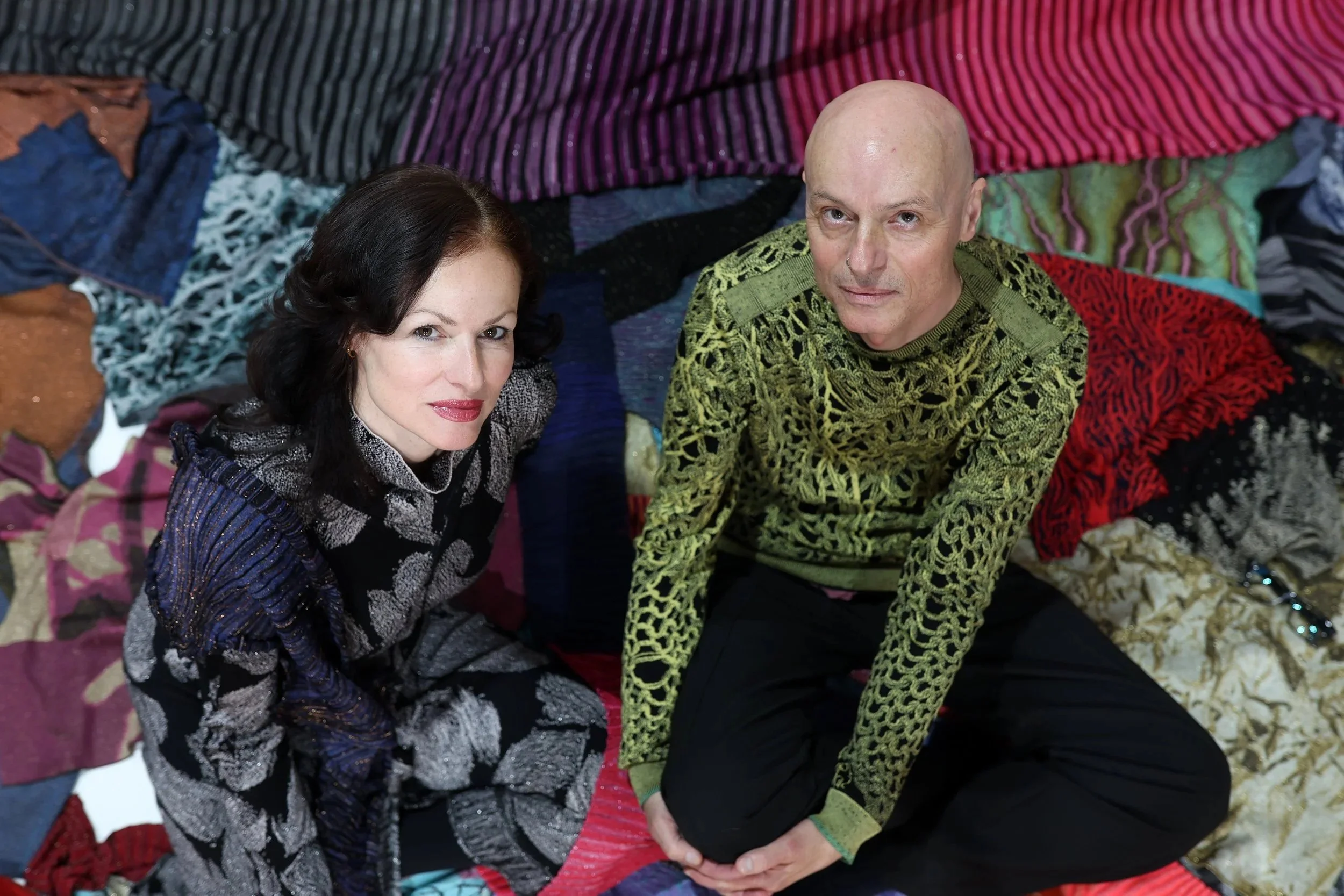
For those who might not know you yet, how would you introduce yourselves?
Urška: I’m Urška Draž. I would first introduce myself as a person without a formal profession, as a mother, and then as a designer. I’ve been making clothes since I was six years old — first with the help of my mother and later developing on my own.
For more than 30 years now, I’ve been working together with my brother Tomaž at Draž Studio. We create garments that are predominantly knitted — about 90% are fully knitted pieces, while the remaining 10% combine knitwear with woven fabric.
Tomaž: My name is Tomaž Draž, Urška calls me “Tomo.” I’m also a father of two children. My hobby is my dog — an active sports dog who is also a member of our family.
For me, my hobby and my job are one and the same. I feel so good at work that I don’t feel the need to go on vacation. I’m responsible for the development and production of knitted textures.
Where do you usually draw inspiration from, and what role does research play in shaping your creative process?
Tomaž: Everything is an experiment. There’s always a desire to move forward — progress is the main driving force. And you can only progress by researching and experimenting.
Urška: At the beginning, when we first started knitting, our experimentation was focused on slightly impractical silhouettes and on researching animal skin structures. We weren’t really thinking about the people who would wear our garments. Today, we experiment more with themes and patterns. But with every experiment, we always keep the final image of the person who will wear the garment in mind — that is our guiding principle.
At fashion shows, we always present pieces that are wearable. For me, this is the highest form of textile design. Our clients have been wearing our work for over 30 years — they want functional pieces that are not ordinary. This is where the most research happens. These experiments have become so natural to us that we’re no longer afraid of them, and they don’t take up much time. There’s a kind of “flow” present in our studio.
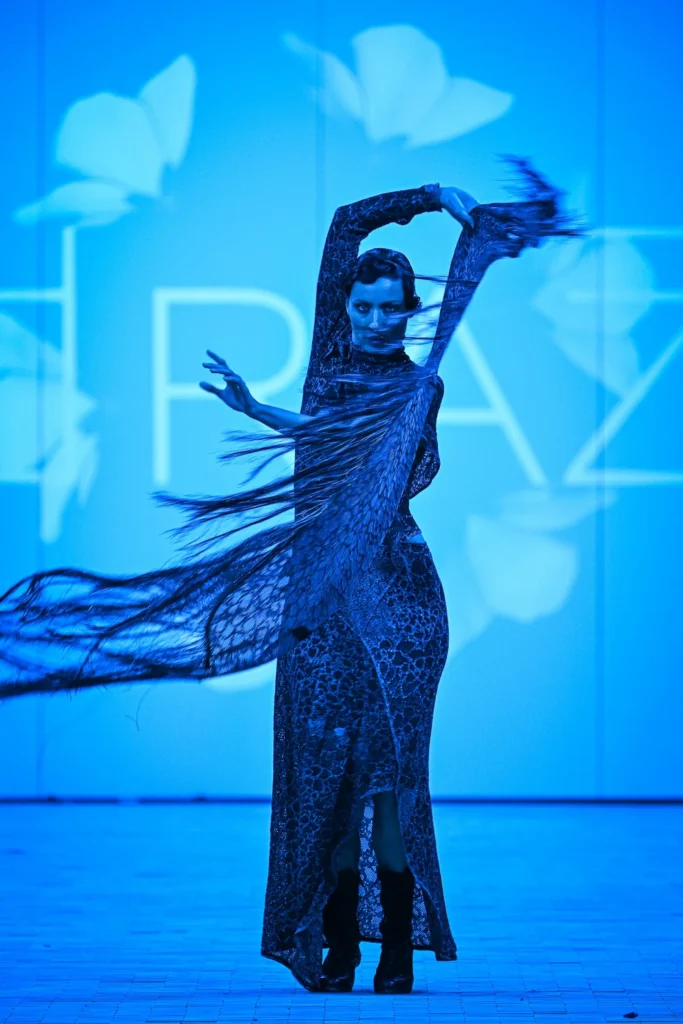
We constantly upgrade our work through different stitches, construction methods, knitting techniques, patterns, or uses of materials — we’re always refining
Tomaž: It’s not about revolutionary changes, but about progress step-by-step. We want to create human-friendly clothing — clothes that work, that are not museum exhibits or collector’s items, but garments that live with people and have a very long lifespan.
We focus on using durable materials. After 30 years, we’ve realized that our knitwear is so robust that it’s passed down from generation to generation. People even bring back garments that are 20 years old to be restored so we can extend their lifespan.
Urška: Not restored in the strict sense — restoration would mean returning something to its original state. We upgrade the pieces, because over the years, especially the female body changes a lot. If earlier we wanted very fitted silhouettes, maybe that’s no longer the case. We renew and adapt the garments so that the cut suits a woman’s current life again.
I’ve noticed that you prefer not to use wool in your knitwear, which is quite interesting since it’s such a common material in the field. But your knitwear isn’t just beautiful — it’s also incredibly durable, lasting for decades. What led you to make that choice and how do you make sure the materials you use remain both environmentally friendly and made to last?
Urška: About 80% of the materials we use are natural; the remaining 20% are synthetic. Among the synthetic ones is yarn recycled from plastic bottles.
These synthetic materials are durable and warm. When we mix them with viscose and cotton — cellulose-based and plant fibers — they become even more pleasant to wear, durable, and warm.
Pure wool can be problematic for people who are sensitive to itching; many people are allergic to wool fibers. You also must ensure that garments contain enough natural fibers so people don’t sweat in them, that they’re machine washable, and that they have a long lifespan. We achieve this by blending different components — that’s our specialty.
Tomaž: A single yarn is always made up of multiple threads. For example, wool, viscose, and cotton are intertwined. This gives knitwear stability. If wool is used in the yarn, polyester is always added, because that makes the wool more durable.
Urška: The sweater I’m wearing is 10 years old. I just dry it flat — no ironing. We like a simple lifestyle when it comes to clothing, and we don’t like garments that require a lot of maintenance.
Tomaž: I don’t even own an iron at home. I don’t iron anything. Of course, ironing is very important during the production process. After we knit a piece, we wash it, dry it, and then steam it. That stabilizes the garment, so it keeps its shape.
Over the years, technology and manufacturing have changed a lot. Recently, you’ve even incorporated AI into your collections — how have these advancements influenced your work, and what has been the biggest challenge in adapting to them?
Tomaž: We express ourselves a lot through jacquard knitting. At one point, we felt it was a shallow medium, because we wanted everything to be abstract, hand-knitted, and three-dimensional.
Then we created a portrait using jacquard and realized it could be pleasant and elegant. We started experimenting and discovered that one stitch equals one pixel. That means you can work in Photoshop and use modern image-processing tools. Digital photography and knitted textures are closely related.
How does AI help you creatively?
Tomaž: We started working with Photoshop 15 years ago. About three years ago, artificial intelligence entered the picture.
This year’s collection is already the third one where we’ve used AI. We use it to generate patterns — AI allows you to create patterns that don’t exist in reality, to synthesize different motifs. For example, it can generate crocheted lace made of wooden branches or glass fibers — something new, something fantastical.
I see AI as a new tool. Some say it has no soul, but in a way, it does — if you have one.
You’ve mentioned that your work often involves experimenting with knitting machines and using them in ways they weren’t originally intended for. Does your background in electronics engineering help you innovate within knitwear design, and what role does trial and error play in that process?
Tomaž: I have a story about this. Our knitting-machine mechanic once told me that during times of high unemployment, knitwear companies liked hiring electronics engineers as machine operators. You show them how the machine works once, and they remember it.
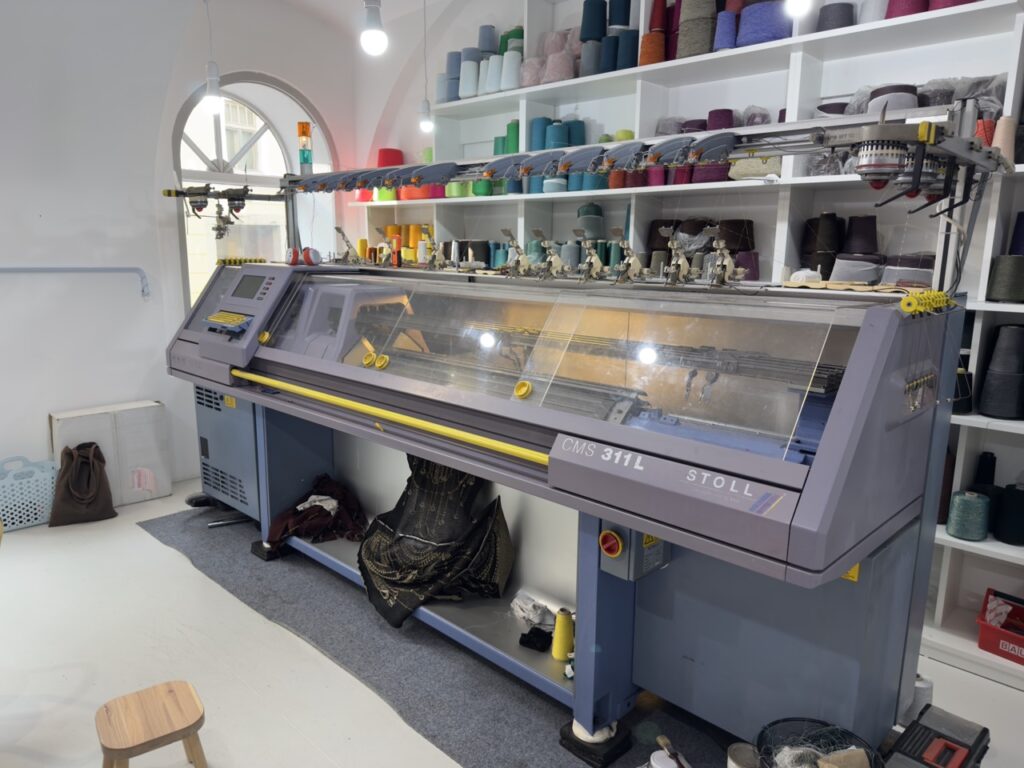
I had a similar experience at the beginning of my career. A classmate helped me with work — we were also selling knitting machines at the time. When you sold a machine, you had to assemble it at the client’s place and teach them the basics. I explained it to him once, and he immediately knew everything.
You’ve been creating under the Draž brand for over 3 decades, since 1988, a time before the internet, online shops, or modern marketing. How do you see the development of the Slovenian fashion scene over this period? How did you source materials, find suppliers, and build recognition for your brand back then, and how has that process evolved over the years?
Urška: The beginnings were bold and experimental. When I was at university, I dressed myself in my own designs — sometimes I felt like I was wearing a costume. My appearance often made people ask, “Where did you get that?”. That’s how you start building confidence as a designer — you realize that what you’re doing is something others can’t or don’t do.
We got a lot of magazine articles because we were different. There were also many fashion competitions back then. At a fashion show in Opatija, we presented a collection, and somehow Josipa Lisac happened to be there — she wanted to wear one of our dresses at the show. We didn’t pay anything; it all happened spontaneously.
At a young designers’ competition in Budapest, Paco Rabanne was on the jury and awarded us first prize. These experiences gave us a sense of worth as designers. At the same time, when we opened our studio on Kotnikova Street, passers-by laughed and asked, “Who would even wear this?” — so we also got plenty of cold showers.
We started creating things people loved to wear, but we remained true to ourselves. We didn’t adapt just to please others.
Tomaž: As for materials, there was a local representative for Italian yarns with a wide selection — we still work with him today. In the 1990s, factories required you to buy large quantities of a single material. That would have required huge storage space and finances.
Today, factories offer “stock service,” meaning you can buy just one cone of different materials and colors.
Urška: Since Ljubljana Fashion Week started, it’s been much easier. Designers get professional videos and images — a full presentation package that didn’t exist before. We also had the advantage that we wear our own clothes, which builds trust. We don’t sell one thing and live another life. That’s extremely important, especially for micro-designers like us. Trust between designer and client is everything.
Have you considered expanding to other markets?
Urška: We had several attempts, all of which ended with our pieces being sold but not paid for. Without our base here and our own store, we could have gone bankrupt several times because of this.
After such experiences, you ask yourself why you’d even try. We might explore online sales, but we want to maintain a fair, human relationship with customers. We repair old pieces and value direct contact. If we go online, we want a human-centered approach, not one driven by algorithms. That requires development and resources we haven’t reached yet — but that’s our plan.
Do you think it’s easier or harder for young designers to get started today? Why? Would you do anything differently if you would have started today?
Urška: I think it’s harder because there’s too much information, too much of everything. It’s harder to build an identity due to social media, and harder to stand out with something truly personal.
At the same time, it’s easier to present your work. But building a loyal community is harder because the market is saturated. Trust is crucial. I’ll give an example: a client once chose a very bright color. I warned her it might not be right. She insisted. When we started assembling the dress, I felt it was wrong and called her back. I told her I wouldn’t wear such a dress myself. She realized she’d made a mistake.
We made her a different dress and used the first one elsewhere. We didn’t let that piece leave the studio. That’s how trust is built — by not saying, “You ordered it, now you must take it.” That’s how you gain loyal customers.
One of your most recognizable collaborations has been with Alpina since 2014. How does designing footwear differ from creating clothing and accessories? Did you knit the shoes yourselves, and what technical challenges did you face along the way?
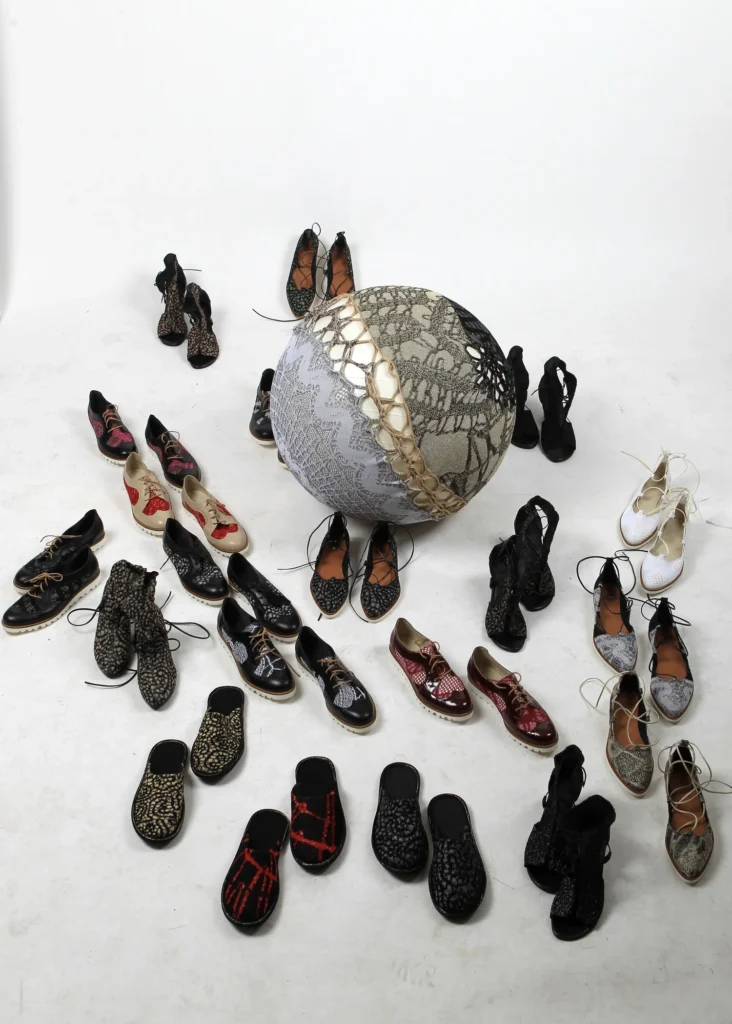
Urška: The collaboration is no longer ongoing. Since 2022, when Alpina was sold, there has been no interest in continuing the partnership. Their core focus is sports and alpine footwear. It’s a pity because the response to our work was incredibly positive. We do believe, however, that we’ll make these sneakers again ourselves, as they were a really good product and affordably priced. We updated the base model and wrapped it in knitwear, and I think we’ll develop it again.
Did you make the knit yourselves?
Urška: Yes. We developed a special knit that was different from the one used for garments — more durable, using different materials, while the patterns could remain the same. Alongside the wedding dress, we also created matching sneakers. All the knitwear was made in our studio; the footwear was developed as a semi-finished product here. The knit was not applied afterward — each shoe was designed and shaped as part of the process from the start.
How does the knit differ for footwear?
Tomaž: You need to focus on durability rather than comfort against the skin, since all the shoes were lined. The knitting could therefore be firmer, and often also much shinier.
To conclude, what advice would you give to young designers starting out in the fashion industry?
Urška: They should build their own identity and find someone who can help them tell their story — who they want to become in five years — so they’re not alone in the world. They should find partners who can help them build that narrative and discover a path that is entirely their own, one that no one else has explored yet.
They should follow as few rules and trends as possible. If you open Instagram today, it’s full of advice that makes you feel like an idiot for not knowing everything. It’s important to be aware of your own value and to remember that as a fashion designer, you work for people, not for your ego.
The ego must be present, because you need it to grow — but in the end, you must remain humble and grateful that there are people for whom you are able to create.
Tomaž: I would say they should develop hands-on skills and explore every process — from the very beginning to the final construction of a garment. At the start, they should stand in front of the mirror and build their complete personal image.
Written by Jakob Pavlovic
Edited by Thomas Hu