Tag: Brand

  • Codex Interview: Draž Studio

    Codex Interview: Draž Studio

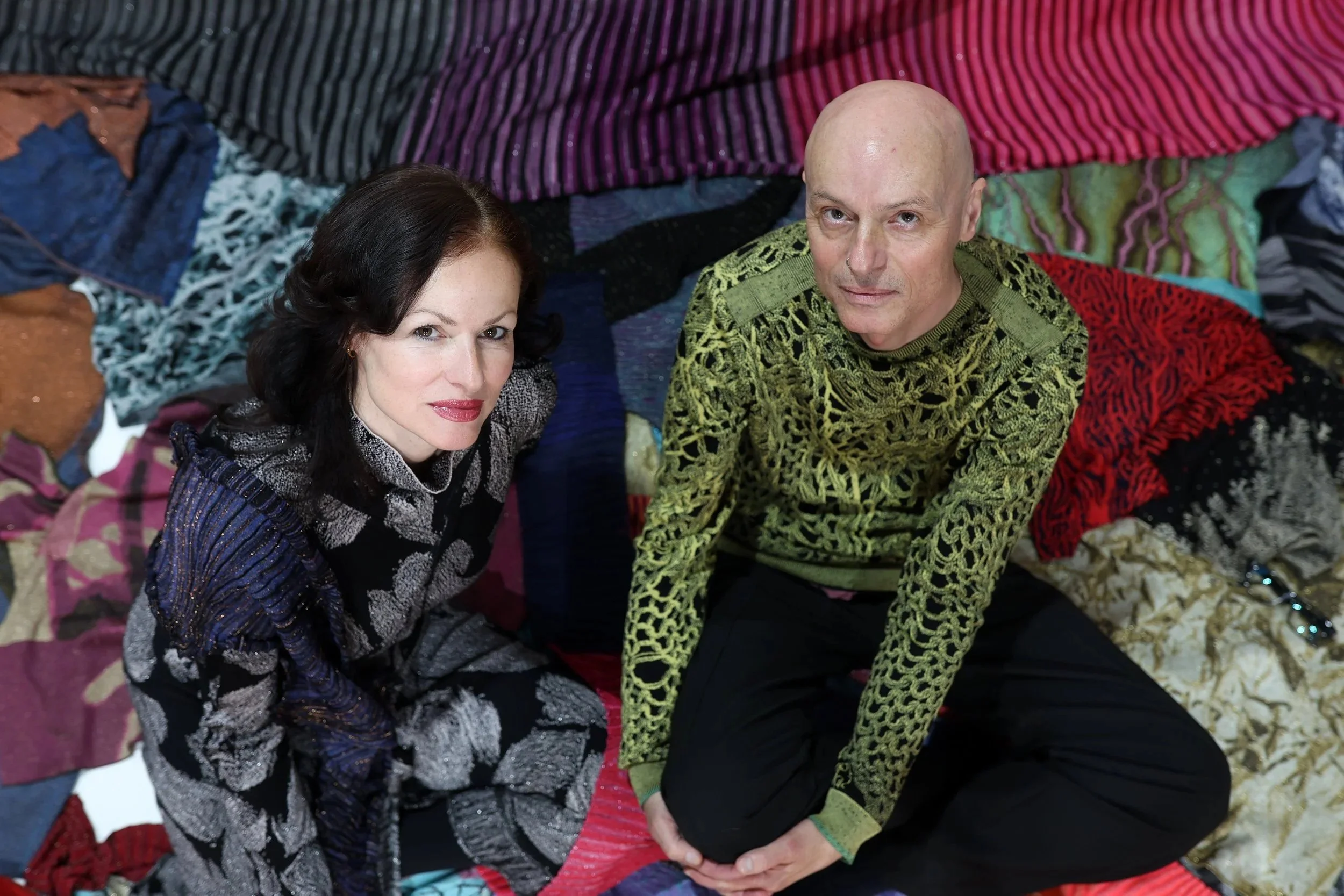
    We sat down with Slovenian designer duo Urška & Tomaž Draž, at the lobby café of Allegro Hotel in Ljubljana, just across the street from their studio, to explore their unique approach to knitwear, their design process and how their design philosophy has evolved in over three decades of work at Draž Studio.
    For those who might not know you yet, how would you introduce yourselves?

    Urška: I’m Urška Draž. I would first introduce myself as a person without a formal profession, as a mother, and then as a designer. I’ve been making clothes since I was six years old — first with the help of my mother and later developing on my own. 

    For more than 30 years now, I’ve been working together with my brother Tomaž at Draž Studio. We create garments that are predominantly knitted — about 90% are fully knitted pieces, while the remaining 10% combine knitwear with woven fabric.

    Tomaž: My name is Tomaž Draž, Urška calls me “Tomo.” I’m also a father of two children. My hobby is my dog — an active sports dog who is also a member of our family.

    For me, my hobby and my job are one and the same. I feel so good at work that I don’t feel the need to go on vacation. I’m responsible for the development and production of knitted textures.

    Where do you usually draw inspiration from, and what role does research play in shaping your creative process?

    Tomaž: Everything is an experiment. There’s always a desire to move forward — progress is the main driving force. And you can only progress by researching and experimenting.

    Urška: At the beginning, when we first started knitting, our experimentation was focused on slightly impractical silhouettes and on researching animal skin structures. We weren’t really thinking about the people who would wear our garments. Today, we experiment more with themes and patterns. But with every experiment, we always keep the final image of the person who will wear the garment in mind — that is our guiding principle. 

    At fashion shows, we always present pieces that are wearable. For me, this is the highest form of textile design. Our clients have been wearing our work for over 30 years — they want functional pieces that are not ordinary. This is where the most research happens. These experiments have become so natural to us that we’re no longer afraid of them, and they don’t take up much time. There’s a kind of “flow” present in our studio.
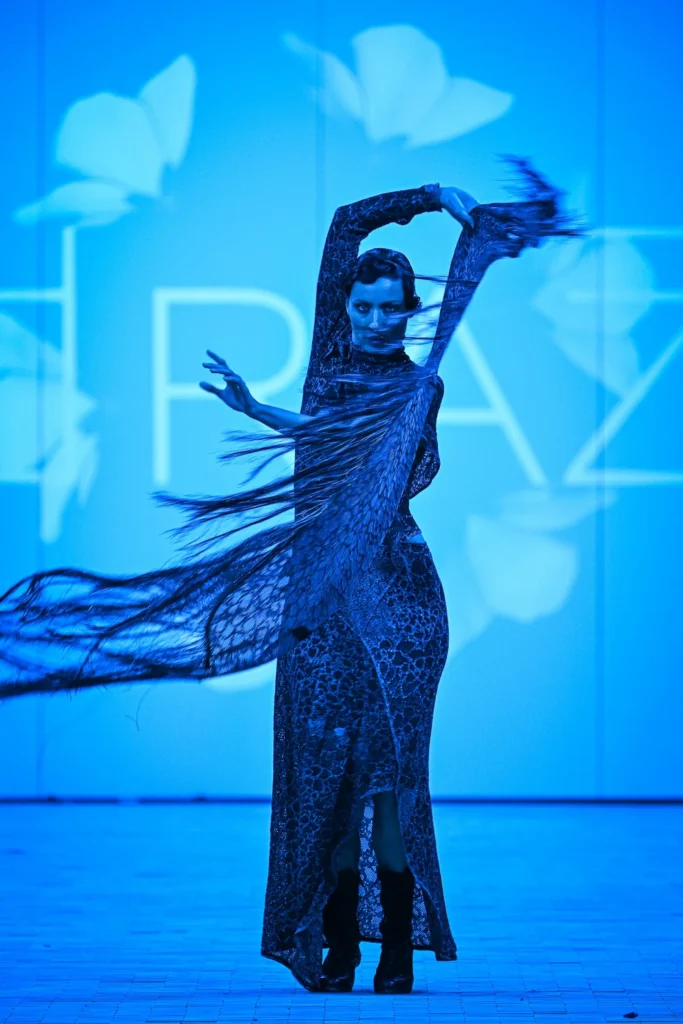
    We constantly upgrade our work through different stitches, construction methods, knitting techniques, patterns, or uses of materials — we’re always refining

    Tomaž: It’s not about revolutionary changes, but about progress step-by-step. We want to create human-friendly clothing — clothes that work, that are not museum exhibits or collector’s items, but garments that live with people and have a very long lifespan. 

    We focus on using durable materials. After 30 years, we’ve realized that our knitwear is so robust that it’s passed down from generation to generation. People even bring back garments that are 20 years old to be restored so we can extend their lifespan.

    Urška: Not restored in the strict sense — restoration would mean returning something to its original state. We upgrade the pieces, because over the years, especially the female body changes a lot. If earlier we wanted very fitted silhouettes, maybe that’s no longer the case. We renew and adapt the garments so that the cut suits a woman’s current life again.

    I’ve noticed that you prefer not to use wool in your knitwear, which is quite interesting since it’s such a common material in the field. But your  knitwear isn’t just beautiful — it’s also incredibly durable, lasting for decades. What led you to make that choice and how do you make sure the materials you use remain both environmentally friendly and made to last?

    Urška: About 80% of the materials we use are natural; the remaining 20% are synthetic. Among the synthetic ones is yarn recycled from plastic bottles.

    These synthetic materials are durable and warm. When we mix them with viscose and cotton — cellulose-based and plant fibers — they become even more pleasant to wear, durable, and warm.

    Pure wool can be problematic for people who are sensitive to itching; many people are allergic to wool fibers. You also must ensure that garments contain enough natural fibers so people don’t sweat in them, that they’re machine washable, and that they have a long lifespan. We achieve this by blending different components — that’s our specialty.

    Tomaž: A single yarn is always made up of multiple threads. For example, wool, viscose, and cotton are intertwined. This gives knitwear stability. If wool is used in the yarn, polyester is always added, because that makes the wool more durable.

    Urška: The sweater I’m wearing is 10 years old. I just dry it flat — no ironing. We like a simple lifestyle when it comes to clothing, and we don’t like garments that require a lot of maintenance.

    Tomaž: I don’t even own an iron at home. I don’t iron anything. Of course, ironing is very important during the production process. After we knit a piece, we wash it, dry it, and then steam it. That stabilizes the garment, so it keeps its shape.

    Over the years, technology and manufacturing have changed a lot. Recently, you’ve even incorporated AI into your collections — how have these advancements influenced your work, and what has been the biggest challenge in adapting to them?

    Tomaž: We express ourselves a lot through jacquard knitting. At one point, we felt it was a shallow medium, because we wanted everything to be abstract, hand-knitted, and three-dimensional.

    Then we created a portrait using jacquard and realized it could be pleasant and elegant. We started experimenting and discovered that one stitch equals one pixel. That means you can work in Photoshop and use modern image-processing tools. Digital photography and knitted textures are closely related.

    How does AI help you creatively?

    Tomaž: We started working with Photoshop 15 years ago. About three years ago, artificial intelligence entered the picture.

    This year’s collection is already the third one where we’ve used AI. We use it to generate patterns — AI allows you to create patterns that don’t exist in reality, to synthesize different motifs. For example, it can generate crocheted lace made of wooden branches or glass fibers — something new, something fantastical. 

    I see AI as a new tool. Some say it has no soul, but in a way, it does — if you have one.

    You’ve mentioned that your work often involves experimenting with knitting machines and using them in ways they weren’t originally intended for. Does your background in electronics engineering help you innovate within knitwear design, and what role does trial and error play in that process? 

    Tomaž: I have a story about this. Our knitting-machine mechanic once told me that during times of high unemployment, knitwear companies liked hiring electronics engineers as machine operators. You show them how the machine works once, and they remember it.
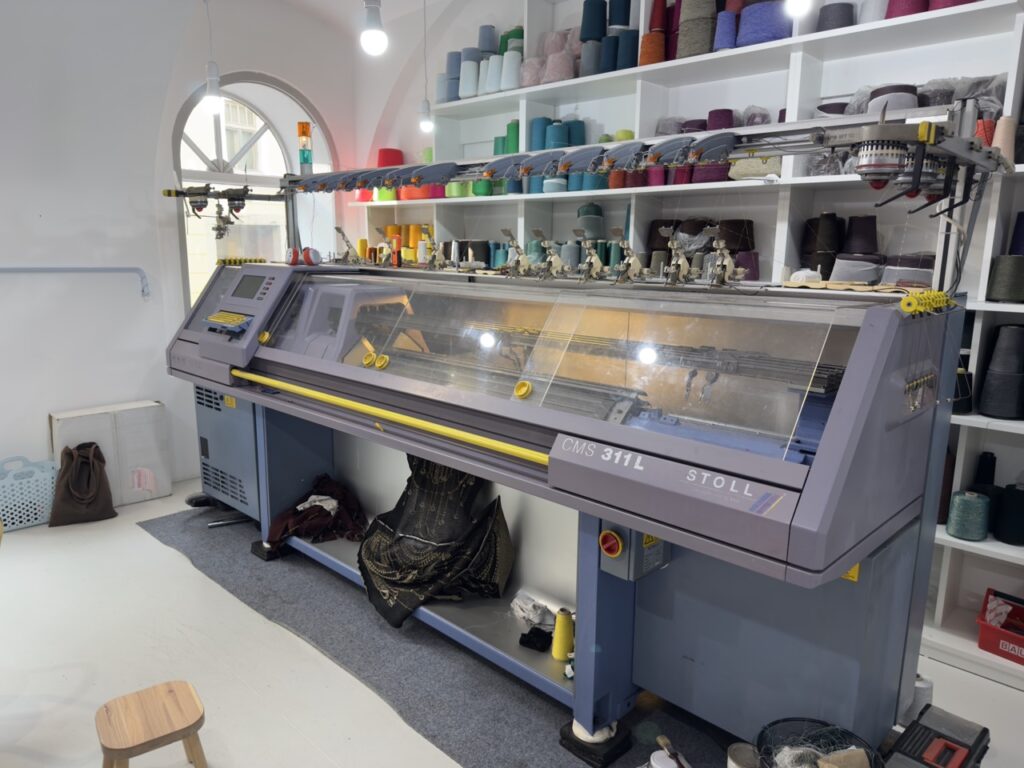
    I had a similar experience at the beginning of my career. A classmate helped me with work — we were also selling knitting machines at the time. When you sold a machine, you had to assemble it at the client’s place and teach them the basics. I explained it to him once, and he immediately knew everything.

    You’ve been creating under the Draž brand for over 3 decades, since 1988, a time before the internet, online shops, or modern marketing. How do you see the development of the Slovenian fashion scene over this period? How did you source materials, find suppliers, and build recognition for your brand back then, and how has that process evolved over the years?

    Urška: The beginnings were bold and experimental. When I was at university, I dressed myself in my own designs — sometimes I felt like I was wearing a costume. My appearance often made people ask, “Where did you get that?”. That’s how you start building confidence as a designer — you realize that what you’re doing is something others can’t or don’t do.

    We got a lot of magazine articles because we were different. There were also many fashion competitions back then. At a fashion show in Opatija, we presented a collection, and somehow Josipa Lisac happened to be there — she wanted to wear one of our dresses at the show. We didn’t pay anything; it all happened spontaneously.

    At a young designers’ competition in Budapest, Paco Rabanne was on the jury and awarded us first prize. These experiences gave us a sense of worth as designers. At the same time, when we opened our studio on Kotnikova Street, passers-by laughed and asked, “Who would even wear this?” — so we also got plenty of cold showers.

    We started creating things people loved to wear, but we remained true to ourselves. We didn’t adapt just to please others.

    Tomaž: As for materials, there was a local representative for Italian yarns with a wide selection — we still work with him today. In the 1990s, factories required you to buy large quantities of a single material. That would have required huge storage space and finances.

    Today, factories offer “stock service,” meaning you can buy just one cone of different materials and colors.

    Urška: Since Ljubljana Fashion Week started, it’s been much easier. Designers get professional videos and images — a full presentation package that didn’t exist before. We also had the advantage that we wear our own clothes, which builds trust. We don’t sell one thing and live another life. That’s extremely important, especially for micro-designers like us. Trust between designer and client is everything.

    Have you considered expanding to other markets?

    Urška: We had several attempts, all of which ended with our pieces being sold but not paid for. Without our base here and our own store, we could have gone bankrupt several times because of this.

    After such experiences, you ask yourself why you’d even try. We might explore online sales, but we want to maintain a fair, human relationship with customers. We repair old pieces and value direct contact. If we go online, we want a human-centered approach, not one driven by algorithms. That requires development and resources we haven’t reached yet — but that’s our plan.

    Do you think it’s easier or harder for young designers to get started today? Why? Would you do anything differently if you would have started today?

    Urška: I think it’s harder because there’s too much information, too much of everything. It’s harder to build an identity due to social media, and harder to stand out with something truly personal.

    At the same time, it’s easier to present your work. But building a loyal community is harder because the market is saturated. Trust is crucial. I’ll give an example: a client once chose a very bright color. I warned her it might not be right. She insisted. When we started assembling the dress, I felt it was wrong and called her back. I told her I wouldn’t wear such a dress myself. She realized she’d made a mistake.

    We made her a different dress and used the first one elsewhere. We didn’t let that piece leave the studio. That’s how trust is built — by not saying, “You ordered it, now you must take it.” That’s how you gain loyal customers.

    One of your most recognizable collaborations has been with Alpina since 2014. How does designing footwear differ from creating clothing and accessories? Did you knit the shoes yourselves, and what technical challenges did you face along the way?

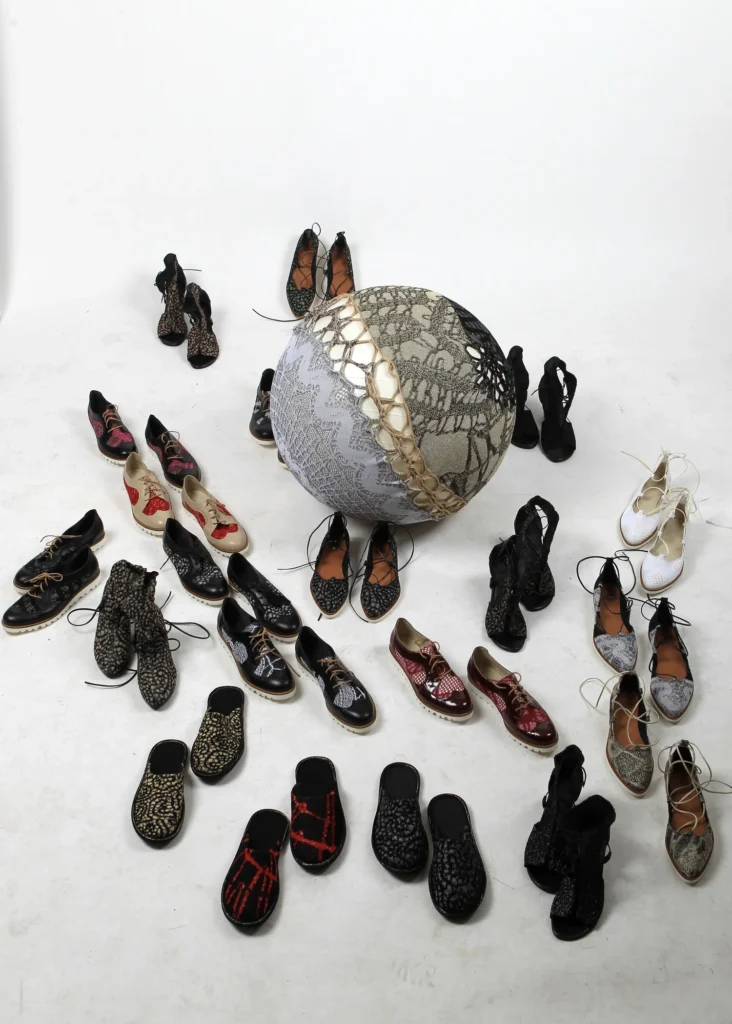
    Urška: The collaboration is no longer ongoing. Since 2022, when Alpina was sold, there has been no interest in continuing the partnership. Their core focus is sports and alpine footwear. It’s a pity because the response to our work was incredibly positive. We do believe, however, that we’ll make these sneakers again ourselves, as they were a really good product and affordably priced. We updated the base model and wrapped it in knitwear, and I think we’ll develop it again.
    Did you make the knit yourselves?

    Urška: Yes. We developed a special knit that was different from the one used for garments — more durable, using different materials, while the patterns could remain the same. Alongside the wedding dress, we also created matching sneakers. All the knitwear was made in our studio; the footwear was developed as a semi-finished product here. The knit was not applied afterward — each shoe was designed and shaped as part of the process from the start.

    How does the knit differ for footwear?

    Tomaž: You need to focus on durability rather than comfort against the skin, since all the shoes were lined. The knitting could therefore be firmer, and often also much shinier.

    To conclude, what advice would you give to young designers starting out in the fashion industry?

    Urška: They should build their own identity and find someone who can help them tell their story — who they want to become in five years — so they’re not alone in the world. They should find partners who can help them build that narrative and discover a path that is entirely their own, one that no one else has explored yet.

    They should follow as few rules and trends as possible. If you open Instagram today, it’s full of advice that makes you feel like an idiot for not knowing everything. It’s important to be aware of your own value and to remember that as a fashion designer, you work for people, not for your ego.

    The ego must be present, because you need it to grow — but in the end, you must remain humble and grateful that there are people for whom you are able to create.


    Tomaž: I would say they should develop hands-on skills and explore every process — from the very beginning to the final construction of a garment. At the start, they should stand in front of the mirror and build their complete personal image.

    Written by Jakob Pavlovic

    Edited by Thomas Hu
  • Codex Interview: RENÈ

    Codex Interview: RENÈ

    We sat down with Østergaard on a regular cold winter afternoon via Zoom to learn more about his upbringing, his design language, and what is next for the Copenhagen-based designer.


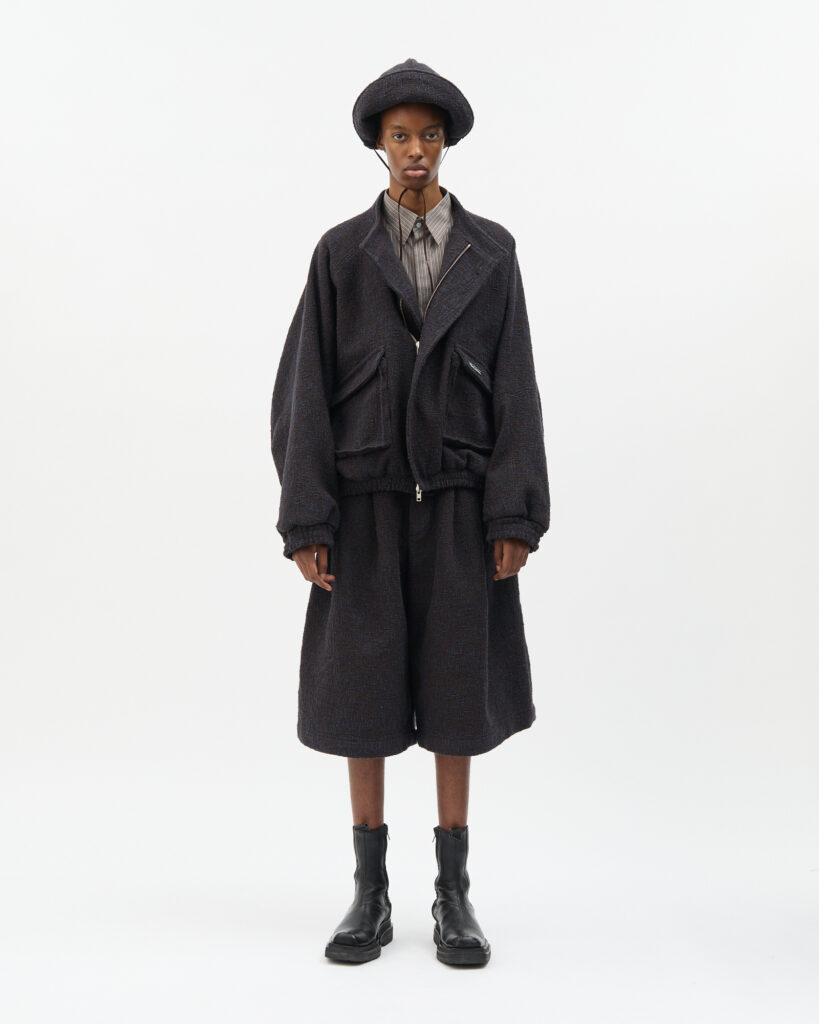
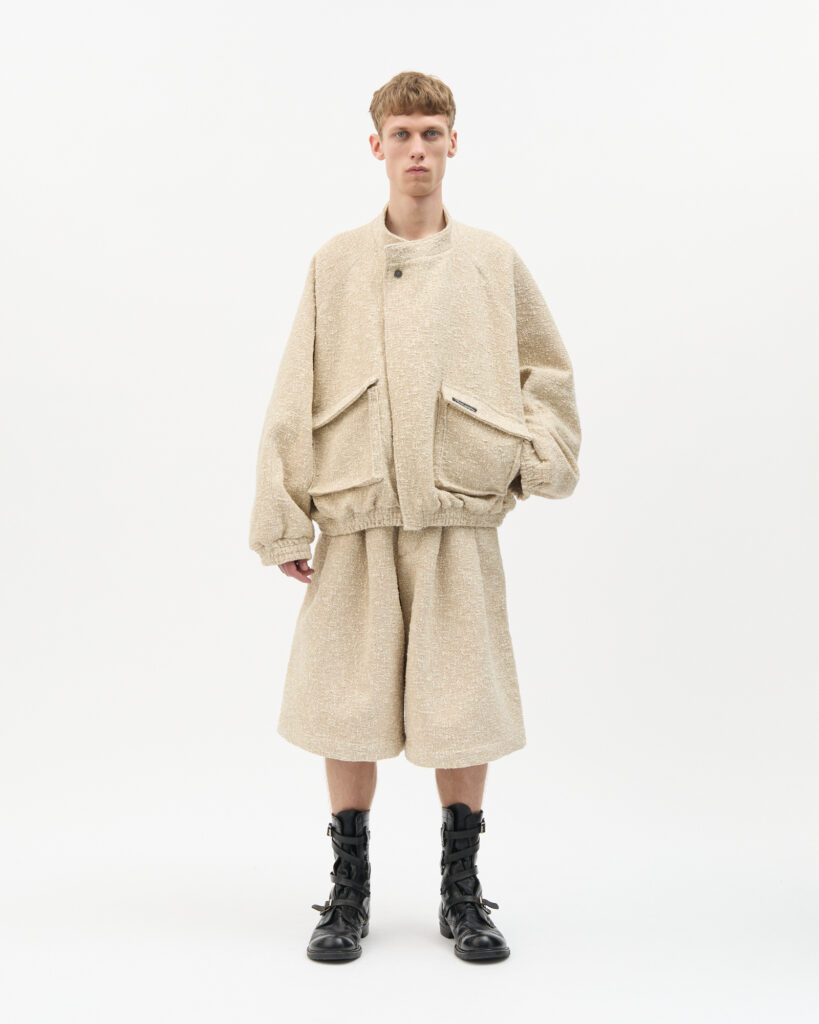
    Presented at the bi-annual fashion fair CIFF (Copenhagen International Fashion Fair) during Copenhagen Fashion Week, Jens Skov Østergaard’s work with RENÈ stood out as a key highlight. We were immediately struck by the rustic, raw materials and the enchanting design language, which merges Thai craftsmanship with Nordic design.

    At the fair, Østergaard showed us the latest collection, “Norse Saga,” at their booth by the main entrance. The story of the collection mesmerised us, with odes to the old, cold, and harsh medieval period. The collection featured unique soldier and peasant-like silhouettes inspired by the Middle Ages, whilst exploring different textures, fabrics, and landscapes, whilst adhering to the synonymous rustic RENÈ aesthetic.

    Østergaard wasn’t always destined to be a fashion designer. Raised as the son of a priest and a doctor and trained to become a nurse, the choice to pursue a career in fashion design feels particularly bold. His participation in the Danish TV programme “Danmarks Næste Tøjdesigner” accelerated his decision to commit to his brand, RENÈ, and to fulfill his creative vision.

    We’ll begin with something easy. Can you please introduce yourself to our readers?

    My name is Jens Skov Østergaard, and I am the creative director of RENÈ, which I run together with my wife, Kridipat. We focus on oversized genderless garments and have a slightly rustic take on unisex clothing. We pay great attention to fabrics and silhouettes to create a contemporary look. Regarding the fabrics, we work a lot with deadstock – our main suppliers for this are furniture companies in Copenhagen. It allows us to create structured, beautiful silhouettes.

    What types of work does your wife do at RENÈ?
    We are both designers; she is from Thailand, where we produce a lot of our garments. She is our connection to the manufacturers and also handles logistics, communication, and our social media presence. My wife has a part in our designs, too, of course. I’d say our roles are quite mixed, and, in a way, we do everything together.

    Based on our research, you developed an affection and interest in fashion at a young age. Picking up interest in clothes, and textiles specifically, what initially piqued your interest, and how did it evolve into fashion design? 

    My grandmother used to sew and introduced me to it when I was very young. At that point in time, it didn’t really catch my attention – I had too much energy to sit down and work with a sewing machine. Years went by, and then I developed an interest in fashion in general, whilst studying medicine in Aalborg. I eventually quit my studies in order to pursue a career in fashion. I like human anatomy, and how you can manipulate the body with oversized clothes. I later applied for fashion school, where I met my wife, who was already working as a designer for a brand. That was how it all started. She had all the connections in Thailand; over there, everything is a bit simpler when it comes to production. I started making a suit, produced it in Thailand, and sold a few pieces; that is basically the beginning of our story. This eventually allowed me to experiment more freely with the type of garments I wanted to make.

    How did the decision to manufacture your clothes in Thailand come to fruition? Was it something you both unanimously agreed was a sensible way forward?

    Kridipat already had her own brand, for which the manufacturing took place there. It was very simple, I could bring a pattern or a sample to a manufacturer, and they would make it in no time. The idea of creating my own brand, at the time, was more of a fun side gig and a hobby. It wasn’t something I intentionally pursued; I wasn’t setting up brand directions and business plans. It was more of a: “Ok, I have a fairly good understanding of how things work” – that is how it all came together, I’d say.
    Later on, right before I started working on my bachelor’s project, I received a message from a scout working for the Danish TV programme  “Danmarks Næste Tøjdesigner”. They told me to apply, which I did, and it went very well as I managed to reach the final. Meanwhile, I had to create my bachelor’s project on the side, which gave me a lot of motivation to keep pushing myself. I wouldn’t say it was the reason I decided to focus fully on RENÈ, but it really instigated me to work on my brand after I finished my degree. And now I am here, two years and four collections later, which is fun.

    How did the TV programme, “Denmark’s Next Fashion Designer,” impact you as a person, and most importantly, as a designer?

    Very fast and intense. We didn’t really have time to work on the details of our garments. I had to go with my intuition a lot more because they gave us a very strict timeframe. It taught me how to adapt to these circumstances, which are applicable in the industry. It also made me trust my own design language more. Apart from that, it was just a fun experience in general. I don’t think it had much of a bigger impact on me on a personal level.

    RENÈ AW 26 – Image courtesy of RENÈ

    You were also working on RENÈ at the time, correct?
    Yes, so at the time our collections were essentially small batch drops – two jackets, three shirts, and two sets of trousers, that was over a timespan of eight months or so, because we obviously didn’t do seasonal collections.

    Where does the brand name RENÈ come from?
    We decided on the name because we wanted something genderless, so we went through a lot of names which had a clean aesthetic but still matched our brand identity. That is basically it.

    You did one of your internships at FINE CHAOS, correct?
    Yes, it was my first internship at the very start of their brand’s journey. I also interned at two other brands.

    FINE CHAOS’ design language is different from your own and RENÈ’s, albeit there are some similarities. How did your time there and in the other internships shape you as a designer?
    I enjoy their work and their rustic details. I’ve done three internships in total. One was in Italy, at Calcaterra, a womenswear brand – I’d categorise them as a niche luxury brand with oversized garments. Daniele Calcaterra was the key motivator for me; he really pushed me in the direction I’m now in design-wise. He also introduced me to an advanced patternmaker who had been at Louis Vuitton – I was around 24 at the time, and  fell in love with all the work I was exposed to, with oversized silhouettes, big sleeves – fluid yet strict.

    We can see that your time there really shaped your work now that you mention it. There are plenty of influences woven into how you create your silhouettes.

    Exactly. We are mainly focusing on genderless clothing, but our primary target is essentially men. Giorgio Armani is another key inspiration for me, who introduced this masculine silhouette into womenswear, so he’s a very good reference point for me personally.

    Do you enjoy the more “classy” aspects of clothing?

    I do, but with a twist. We are moving more into tailoring and a more utility-like approach to our garments.

    We see an increasing number of designers, especially fresh graduates, starting their own brands. You are one of many. What led you to make that decision, and what type of difficulties and challenges have you faced so far?

    I partook in the TV programme, and simultaneously ran my webshop on the side, so it never really felt like a choice per se. My wife thought that it was the time to go for it: “You have the momentum now, why would you wait five years when it has already started?” At the same time, having your own brand is so: “Oh my god”. I finished school and took RENÈ full-time straight from the get-go. Now it is completely different, and a different reality; we currently have a studio with three interns. There were so many things that I had no experience or knowledge of. Everything from buyers to press, all these things, whilst also focusing on designing and planning collections – it is a lot of work. It forces you to absorb so much knowledge that would have been easier to gain whilst working at another brand, because you’d be able to learn as you go. But you’d also gain insights into when to drop your new season’s collections, the wholesale aspect, and how to manage your production, shipping, and exporting products. There are just so many things that would have been nice to have had some experience with. My recommendation for new designers would be to work at a brand for at least two years to prepare, because you will make so many mistakes on your own, and it’ll cost you time, energy, and money.

    The business aspects of this industry are quite tough, and it’s not something that you’re ever really prepared for. I assume you don’t receive any type of business-related education during your fashion studies?

    No, no, no. Now I spend a lot of time on Excel sheets, and that is me learning it from scratch. It starts with the most basic things, such as setting up your prices with linesheets. And there are so many similar things that you’d be prepared for if you went to business school. But when you’re studying fashion, you get no head start or experience with it. At the same time, it’s a lot of fun, and if you enjoy it, I think it’s definitely worth going for.

    RENÈ AW26 – Image courtesy of RENÈ

    RENÈ is based in Copenhagen, a city that hosts one of the biggest fashion weeks, and as it continues to grow, so does the local competition.
    This means you need a clearer brand identity and, more importantly, a more unique story to tell. How have you managed to set yourself apart from the rest?

    I absolutely love the city. I think our aesthetic is just very different from other brands, especially here. You can find more similarities with Asian brands. Most of the designers I look up to are Asian, not all of them, but most. I am more drawn to the Asian ways of working with patterns compared to the European way. It might sound a bit arrogant to say, but I think we’re quite different. It can make things a bit harder, however, because we have to grow our own niche client base; we don’t have the luxury to just tap into something more Scandinavian. At the same time, Copenhagen is a great base, and from outside of Europe, people seem to really love the city. The city is getting more traction and hype from abroad. We have cool cafés, restaurants, Copenhagen Fashion Week, and CIFF, which has been super helpful to me; they really pushed us. Similar concepts don’t really exist elsewhere in the world.

    Could you tell us about some of the Asian designers you’re inspired by?
    Song Zio, or Songzio the brand, made a really amazing collection this season. I love Uma Wang; she makes crazy cool stuff, and I like Ziggy Chen too. There are also some more deconstructive brands that I like, which are different from us, but are very inspiring.
    Calcaterra is another one, incredible, perfect tailoring, all made in Italy, and very impressive finishing. Hed Mayner, too, with some very cool silhouettes for menswear, and cool textures. Most of my inspirations are fairly new designers to the general public, with fresh takes and not shaped too much by heritage.

    How has CIFF helped you, and RENÈ specifically?

    CIFF was essentially the first one to believe in us. It can be quite hard to get attention from people within the industry, but they quickly helped us by saying that we bring something new to the market. They gave us a good booth at the venue, boosting our visibility and helping us connect with buyers for our brand, including us on their social media channels. It matters so much to us to have them backing us and believing in us.

    You state on your site that “RENÈ blends Scandinavian restraint with Eastern precision.” Could you tell us a bit more about that and your research process to keep in line with that statement?
    In terms of Scandinavian restraint, I feel like we are still keeping it “clean” in a way, maybe not minimal, but we mainly focus on our silhouettes. Our Asian influence comes from paying a lot of attention to oversized loose-fit shapes, especially when it comes to patternmaking. We utilise the Thai heritage by working with local manufacturers. We use a lot of Japanese fabrics for our garments too. We essentially mix the two different design styles of Scandinavia and parts of Asia. My wife, with her background, obviously has different perspectives on design, and we merge our views very well. For example, the collection just presented, we drew inspiration from the early medieval Nordic era. Everything was very, very raw and rough – we combined those emotions and aesthetics whilst exploring moss-like textures, and more rustic drapery. We reinterpreted all this through Asian fabrics, combining both worlds, and tried to create a contemporary way of seeing the two very different clothing styles in one. 

    We see more brands opting for deadstock fabrics and materials. Do you think that it sometimes limits your capacity to design and produce clothes that you had first envisioned, or does it allow you to challenge yourself and become more creative?

    For sure, you have to be more creative because you are very limited with what you can do and design. You have to come up with new ways of utilising the fabrics in your designs. Because we’re not creating our own fabrics, it’s not entirely made in the way we might want. We may only have one or two colour variations of a certain fabric, and the fabric’s thickness might not always be what we want for a certain design, either, so you have to find ways to adapt and accept that this is what you have to work with. At the same time, it can be fun, too, because it’ll challenge you and make you think:  “How can I incorporate this fabric into this design?” It helped me develop as a designer. For example, we had a very cool Indian deadstock fabric that I wanted to utilise, and I had to ask myself how I would use it.

    You use Computer-Aided Design in your design development process. Could you give us insight into what it’s like to work with CAD?
    You can basically use it for many things, but we mainly use CLO 3D as a design tool. It’s a key part of our process when we create our patterns, but that doesn’t stop us from creating patterns more traditionally, on the table. For example, you can immediately see the silhouette, the colour-way, the textures – you then render it and get a clearer idea of how the garment will look. It’s a fantastic way for us to conduct our patternmaking, and it is easy to experiment with different shapes and ideas – although you might still have to create a physical sample and develop it. But in general, it’s just a great tool for fashion design. 

    We create samples in the program;  we later print out the pattern and turn it into a physical sample. We incorporate both methods when we create our samples. But it allows us to create different variations of the same design, especially if you only want to make minor tweaks, such as different colour-ways or shapes, it saves a lot of time and fabric. For us, it’s just a faster way to experiment with our designs.

    With technology evolving and fashion design becoming more simplified, especially with tools like CAD, do you think that there’s a potential loss of love for the more traditional way of patternmaking? 

    Maybe, but I think if you are really good at patternmaking on the table, you will prefer that. Even if you are really good at CAD, it won’t directly translate into a good sample on the table; you have to be good at both to make the correct adjustments and notice potential flaws or issues in the design. It is essentially just patternmaking on the computer, but you need to understand the fundamentals of patternmaking in general. 


    One of your parents is a priest, and you previously studied to become a nurse. Both of those professions require a uniform, and some of your designs come in the same colour-way, silhouettes and more, essentially turning them into sets. Would you say that a part of your design language is to make garments more of an everyday uniform rather than individual pieces?
    I see clothes as an everyday uniform, yes. I want to stick with something that you can easily mix and match. I also love wearing sets myself, and I think it looks very cool on others, too. We design our clothes for longevity by making it easy to mix and match our garments from previous seasons with the latest season. But as a uniform? Yes, I am so used to uniforms; my father is a doctor, I was a nurse, so uniforms have always been around me, and I like wearing them. I like to see people wear the whole RENÈ-look with a bomber jacket and trousers together.

    Before we wrap things up, what is next for you and RENÈ, and what is the end goal?

    Funnily enough, my wife and I were joking around yesterday that we wanted to be part of the LVMH Prize. It’s tough, and we’re many years away from it. I mean, we just want to get our clothes out in the world and have a sustainable, healthy business. We want to set ourselves apart by making nice, distinctive clothes which people will cherish. We’re going to Milan in two weeks to present our autumn/winter collection, which is exciting.

    As RENÈ’s adventure continues through the classic streets of Milan, we eagerly await what they have in store for us for the next iteration of Copenhagen Fashion Week in August. The in-depth knowledge we’ve gained about Jens, his personal story, and RENÈ allows us to further explore and follow their journey as they take another step towards further success.

    Interview conducted on: 13/02/2026 13:00

    Written by Jesper Green

    Edited by Wonne Scrayen

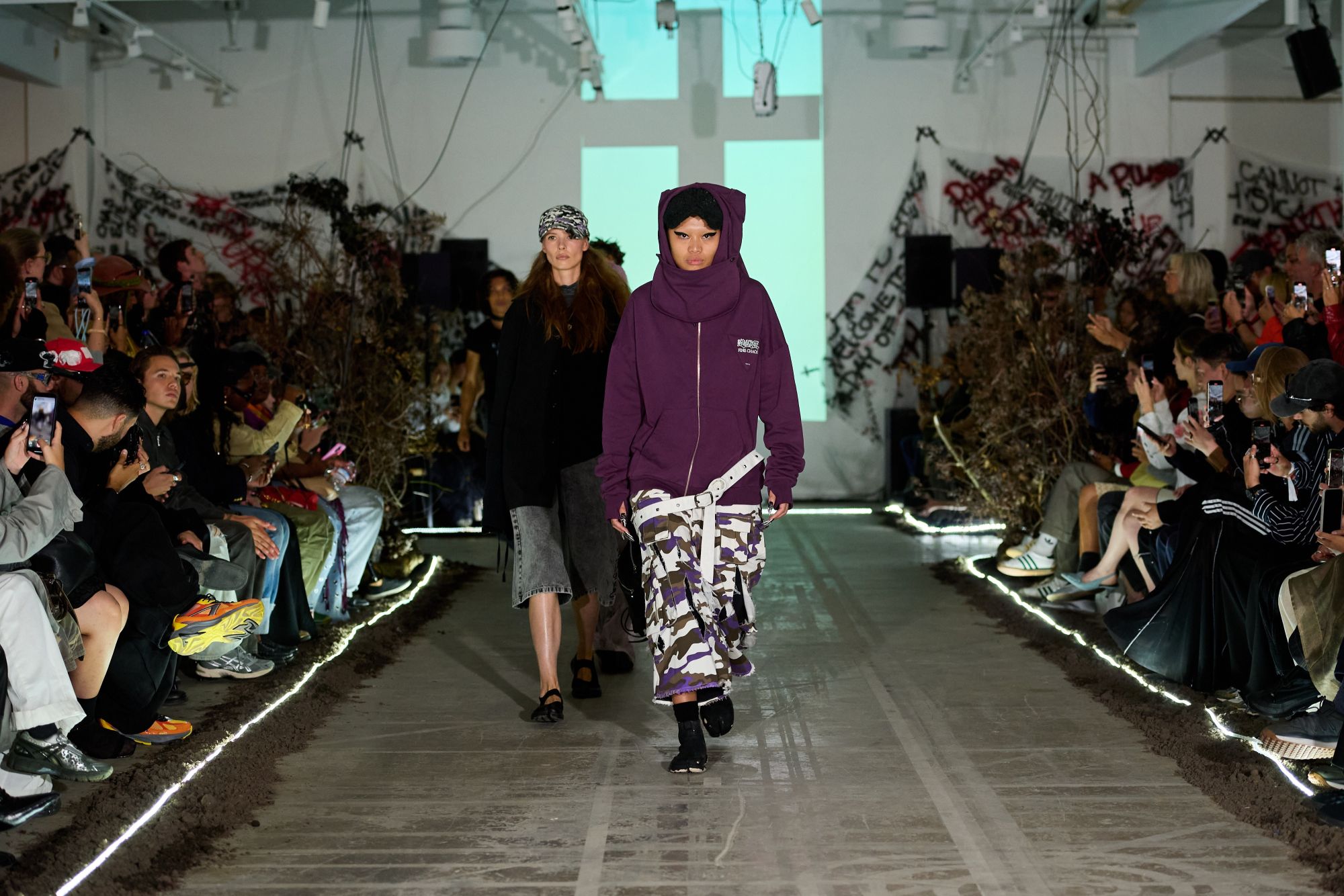
  • Codex Interview: FINE CHAOS

    Codex Interview: FINE CHAOS

    We got the opportunity to witness FINE CHAOS’ “Post Mort3m” runway show in August, fast forward to November and we were able to sit down with one of the co-founders and the creative director, Marc Christiansen Møllerskov. We spent an hour chatting about common acquaintances, friends and interests, but most importantly, about him and the journey of FINE CHAOS.

    You’ve previously interned at Han Kjøbenhavn, which is personally one of my favourite Danish brands. But like many other designers who graduate in this current era, you opted to start your own brand at an early age. Why, in your opinion, do you think more designers opt to start fresh and create their own brands these days. Is it the consistent amount of internships that leads to nothing? Is it the stress of working under someone else’s creative visions? Or do you think it’s just the best way of truly expressing yourself?

    I knew, well, the reason I knew that I wanted to start FINE CHAOS right after my education. Well, I sort of moulded the concept of it whilst I was studying. But I knew it after my internship at Han Kjøbenhavn. The reason for it was because I was in almost every department whilst working with them. So I started off in the design team when we worked on the runway piece construction. We did some very conceptual pieces with boning, and just avant garde in general. Created pattern cutting, and helped the production team with tech packs and such. I wanted to have a full view of how a company worked, because I knew that if I was going to start my own, I wouldn’t have to learn things from scratch after I’ve started it. So I wanted to learn a little bit beforehand so I could prepare myself. So I helped the sales team prepare e-commerce stuff like logistics and such, I helped with the showroom.

    I am a former semi-pro Counter-Strike player, I don’t know if you managed to find that, but it’s because I was known as Marc Christiansen, and not Marc Møllerskov. I wasn’t playing at a top-top level, but I got paid and I partook in tournaments and such. So I have a huge passion for editing and such, with graphic design knowledge from creating team logos and just playing around with Photoshop from a very early age. I think that’s why my knowledge of what good graphics are like, is very strong. Han Kjøbenhavn also picked up on that, and none of them knew how to remove a green screen. From the showroom, there was a model that was rotating 360 degrees, and they wanted to have a “fishbowl” kind of video, and they did not know how to edit that. So I did all the visuals, editing, and the nitty gritty parts of that. I also did tribal patterns, I was part of the early developments of that pattern, which they are using quite frequently now. At the end of my internship, they asked me if I wanted to stay for another six weeks, to help create a whole new knitwear collection and also work on picking the colours for the logo t-shirts and such. But creating the whole knitwear collection was crazy.


    So do you have a speciality in knitwear?

    Uhm, no, no, I didn’t know anything about knitwear before that. I mean, I knew a little bit because I did include knitwear in my final exam, which was after my internship. But I already sort of prepared and studied a bit regarding knitwear, just to have a small understanding. I collaborated with someone from the Faroe Islands for my final exam, and the way she was knitting, she was fusing knitwear and crochet. Crocheting some parts of the garment, and the rest was handknitted in a special pattern as well. I got to learn a lot about gauge and stuff.


    Did you feel like being part of a bigger brand put a limit on your creativity, or were you given free rein?

    It was pretty collaborative, I would say. So Jannick (Creative Director of Han Kjøbenhavn) had a vision for example the knitwear and the artworks. It was very vintage inspired, it consisted of these knitted patchwear sweaters. I basically got to do my version of that, and I incorporated a lot of symbols that Han Kjøbenhavn, at the time, tried to become known for (with the tribal patterns etc). So I think there was a lot of creative freedom actually.


    You’ve studied at Copenhagen School of Design and Business, but also at the London College of Fashion. Did your creative vision change once you went abroad for your studies, or did it just enhance your visions? What were the biggest differences between the two overall?

    I got to learn more about myself, moving to London, I did not have the same amount of time and mind space to figure out who I want to be, in terms of being a designer. But also, what kind of story I’d like to create. I knew very early on that I wanted to create a story that people would care about, also make people feel like it was their own story. I feel like I dug deep into it whilst I was living in London, since I had to get out of my comfort zone. I didn’t know anyone before moving there, so living there for a couple of months helped me dig into my own persona a lot more. Because I get very inspired by my friends, and I didn’t have any friends there, so what inspires you then?

    I had to pick my own brain apart and that is what I did in London. My design process has obviously developed further after starting FINE CHAOS, with moulding the brand’s vision based on yourself and then having a whole team following that direction. Back then, the way we did sketch books and documented processes in London, was crazy, maybe even a little too crazy.

    It inspired me to do even more, for example, exploring different ways of draping, focusing 200% on draping for three days, and what now? I am going to work on my painting, then you paint roughly for another three days, and so you’d break your pencil multiple times. That type of education was new to me. In Copenhagen I learnt more about the value chain and more about how to realise your dreams, whereas London sort of made me dream, if that makes any sense.


    Did you get to study in London during lockdown?

    No, it was just before it happened. I went to school in London whilst living in Denmark, that was crazy. It was fun to do it that way, I had to live at my parents place because I didn’t have a place to stay in Copenhagen. I got to meet some wonderful teachers during my time there, I remember this guy who was so fucking good at draping, he was just draping a blazer and I was so intrigued because lapels has always been a challenge for me. For some reason, I always get the calculations wrong, and during his first lecture I could instantaneously drape a lapel. I was like; “how the fuck can I not do this on a table? But I can do it on a mannequin?” and he said; “because you are working with your mind and not just with your hands”. And I was like, that’s very deep, but I am assuming you understand what I mean, haha. His instructions were so simple and he was so old school but I still felt like he made everything so easy, so it almost felt very futuristic in a sense.


    Your personal style and the design language of FINE CHAOS is very far from the regular Scandi-chic aesthetic that is portrayed by many Danish and Swedish brands. What helped you solidify this aesthetic, and what made you fully believe that it could be a success in Denmark?

    So I don’t think we have solidified it in Denmark actually, I think it’s more of a Copenhagen thing. Our main base is in Copenhagen, whilst we do get people who support us outside of Copenhagen, it’s not as if we have communities outside of the city, which is still a challenge. It actually goes back to when I was growing up, my mum was working in fashion for a clothing brand called Uldahl, a womenswear brand that made very exclusive stuff such as jackets made out of rabbit fur and also had some very punk-like things. My mum has a very punk-like style, it’s her way of being.

    But from an early age, I understood that clothing can spark conversations by being different. So what I did was, I dressed slightly differently, I still followed trends because I wanted to look cool and such in general, from a social hierarchy standpoint I guess. But I still dressed in weird ways, and I always picked colours that were never trendy because I wanted to shape things in my own way. I always got asked why I was doing this and I completely loved it because it was a conversation starter all the time. And the fact that clothing is a medium for it, that it can be so strong, when a stranger can just come up to you and say: “Those are some nice trousers, I wouldn’t dare wearing them myself, but I really appreciate that you’re doing it. Why do you wear them?”

    As you may have realised, I come from a small city so standing out a bit is quite a lot there, with a population of like 5000 people, it’s kind of hard to go outside of your comfort-zone style-wise. But I think that shaped my future and I wanted to keep the same feeling, so I want our clothes to spark a lot of conversations and also connect people. I think it’s a beautiful thing.


    There’s a bit of anarchy against the norm, isn’t there?

    Yeah, it’s so funny because it’s a lot of people who are just saying that I am like “fuck the system” and that I am going against the system and society itself. But I am more so doing things my own way and sometimes we follow the norms. But as Margiela said, you have to know the rules in order to break them. If you know your target groups, you can then just create your own and connect with a lot of people so you don’t become this boring brand that is just for the business person or the techno-goer. Although some people still see us as THE techno-brand of Copenhagen.


    So you’ve had a lot more success abroad, would you agree?

    Yes I would say so, when it comes to wholesale, we’ve had a lot more success in East Asia, which is amazing. I mean, we have a very strong community in Copenhagen. But now with the Yu-Gi-Oh collaboration, it has opened up a lot more for us. I can also go into depth of how and why that collaboration happened. I don’t know if you’ve researched it?


    We can do a lot of research, but if you feel like talking about it right now, feel free to do it!

    I played and collected Yu-Gi-Oh cards when I was a kid. I really love the [Yu-Gi-Oh] anime, and I love Yami Yugi, because he’s this androgynous… Idiot, well, he’s sort of an idiot in this very childish way, because he’s like: “I am the king of games and I’ll win no matter what, and I’ll break every rule that exists in the game, even though I am the creator of the game, I break my own rules”. I really love that rebellious energy in the anime, and that’s probably why I gravitated more towards Yu-Gi-Oh than Pokémon for example. Fast forward till two and a half years ago, I needed a hobby because all I was doing was FINE CHAOS.

    I just remembered my hobby with Yu-Gi-Oh and then I started playing a little bit with some of my friends, whilst also collecting cards. Before you know it, you have a Shiba Inu named Yugi, and his full name is Yami Yugi. We collaborated with WALLHACK, the gaming company, and we made a jacket and two caps with them. Me and their Creative Director bonded, funnily enough his name is also Mark but with a K. We started going to these fairs and he heard about my fascination with Yu-Gi-Oh, and the rest is history. So that [Yu-Gi-Oh collaboration] was a big milestone for us and it was the first time we worked with such a big company.


    We’ve seen FINE CHAOS take a huge leap in the Asian market, particularly in Korea and Japan. Do you think there is a specific reason why you think these markets appear to be doing well? Especially considering the vast differences between the two countries, politically but also the difference in personal style

    By having beautiful people who really believe in your brand from an early point, so a huge shoutout to Opener, that store in Seoul opened so many doors for us. Because it is such a well respected store, they have a certain niche, they don’t care about norms but they care a lot about good clothes. But also very expressive clothing. That niche in Seoul, they are just wilder than the niche we have in Copenhagen. The wealth in Korea has really helped us. But that specific store has helped us in many ways, with Kpop stylists and others going there to do their shopping, and suddenly our clothes are now worn by Kpop stars. It has happened so many times now, and now we’re selling in other stores, in stores that are a bit more bold in their selection, and who support new talents. I mean, we don’t have the biggest track record to show from a B2C standpoint, but they can see that our stuff just works. If you compare Seoul to Copenhagen [sizewise] , naturally the niche is also bigger there you know.

    So that’s pretty much how things started, my fiancé lived in South Korea for four months, and that is how we sort of got in contact with Opener. At that point, we didn’t have our stuff in any of the stores in East Asia, and I was going to give it my all to get a meeting whilst I was there. I messaged a lot of stores, both on email, Twitter, Instagram together with Ludvig. But I think he can give me the credit for the Opener deal, I was sort of the one who established the connection. I knew I was going there, so it made sense.


    What’s your research process like? Where do you look to gather inspiration (aside from anime)? Do you watch films, travel, or read books? What inspires you and your creative work?

    We write a manuscript for every collection which is 30-pages long, and it’s an ongoing story that has been going on for like four seasons now. Those stories are a reflection of the everyday [lives] and the political landscape. But also about what’s going on in the world [in general]. We also get inspiration from people we talk to, so it becomes this full-circle thing. I think that’s just where the main inspiration comes from, life in general. Again, it sounds very cliché but we as a brand, really dare caring about political issues and more “brave” topics that other Scandi-brands don’t want to touch. We present them in a way where it’s not directly saying, for example, our SS25 collection was called ‘FEAR THE DOME: WAR’ and that was when the whole Palestine-Israel conflict was being brought up, alongside Ukraine and Russia.

    We incorporated that in our storytelling with us reflecting on social hierarchies in war and sometimes how the opposites can’t find the beauty in each other, but instead, they try to eliminate each other. It’s not very human, but it’s humans that create these issues. So that is what we do, we try to reflect on these topics in our artwork, our prints. From that storytelling that we do from the manuscript, we try to take all these keywords from the manuscript and do research on how we can interpret this in a graphic way, what kind of silhouettes and more.

    The last collection, Post Mort3m, we looked into a lot of club references. I watched Blade again, which is one of the most legendary films in my opinion. The colours from that film are amazing, and we actually used that colour-scheme for a lot of the prints that are in the collection. So yeah, it’s a summary of a lot of things, but it can also be small things. I remember watching Demon Slayer, the silhouettes, the clothes, the robes and all those things they wore and used. That flow of fabric, even though it’s not real, I want that to be real. There’s a character with tattooed circles on his face, those circles are a symbol of whenever he stole something in the village. So whenever he stole something, they would add another circle to his face. So that’s where we got that reference from (which one?). In our story, FINE CHAOS is the evil company that controls society and everything. We wanted to include that in some of our artwork as well, not as a print, but more as shapes.


    You’re quite outspoken about social injustices, politics and more on your social media platforms, which can also be reflected in your design language, which has a very rebellious aesthetic to it. As we’re quite privileged to live in Scandinavia, do you feel like more people within the industry need to enhance the voices that are screaming for change? Even through fashion?

    Yea I think so, just because the fashion medium can be that [voice]. I understand that some designers just want to live the simple life of making beautiful things, but I also feel like in a world where there’s so much clothing, it sort of needs more purposes than just being beautiful. If our clothes can make people dream about something, or talk about something important. I think that’s a lot more important than a beautiful t-shirt or something.


    You’ve previously mentioned that you watch, and I quote: “a shit ton of anime”, for your inspiration when it comes to your designs. Do you have any specific manga artists and or anime/mangas/characters that specifically come to mind where you consistently seek inspiration from?

    I am very inspired by Gachiakuta, the artstyle, the story and the absurdity of it. I love that a lot. I used to love the concept of ‘Tower of God’, the concept is amazing where you have to go through multiple floors in order to achieve “God status”. I like that because it’s a reflection of life itself, and that was a very fresh take on anime as well.


    Who are some of the key inspirations in your life, in terms of design, and life in general?

    Music in general [insert artist name here] is amazing, he’s joined in so many sessions so it almost feels as if he’s playing for me. I really love his music, because it stimulates weird thinking, I can’t really grasp why, but I think it’s because it’s the level of layers with different instruments and such that sort of categorises electronic music. It’s very inspiring.

    I loved Dante back in the day, it used to be a big reference as well. Basquiat is also something that is everywhere in my house, books, notebooks, even replicas of his notebooks when he was alive, those kinds of things. I love that. His rawness, his honesty in an industry that isn’t honest, it’s super inspiring. I think those are the major ones.

    I have a fascination with uniforms that have developed lately, not just the functionality of them, but the shapes, there are so many small weird shapes in uniforms. I was playing Counter-Strike two days ago and I was looking at the skins as well. It doesn’t make much sense, you have small round pockets everywhere, some of them are sharp and I am like, what kind of objects can you store in them? A knife, a lighter, or what is it for?

    But I am also probably very biased because of the research we did for the last collection, and it also had somewhat similar shapes. But we looked more into the “exclusive” armywear, like [high-ranking] officers and more. That has nothing to do with artists in general, but that really inspired me.


    FINE CHAOS is very open to different types of collaborations, ranging from Yu-Gi-Oh to Cengiz Güdücü. What drove you to pursue collaborations, especially at such an early stage of the brand. Do you have any dream collaborators in the future?

    Nike, it’s the brand that first came to mind. I used to collect Nike shoes, and so did my dad, he still collects Nike Shox. A Fine Chaos x Nike Shox would probably be my dream. Another dream would be to work with Raf Simons on something, I don’t care what it is, but just something. Raf has something that I’d call the “Virgil Syndrome”, he used to do so many small projects. Ranging from small sketches, he made a chair, and industrial design before fashion. There are just so many projects where he had a small influence on. When he joined Prada, I was like, of course he joined Prada. He just loves to do small things.

    My sister is a model, fun fact, about me or well, FINE CHAOS in general, my dad and my sister always walks our shows. My dad was the older guy who was wearing the “I am DJ” shirt. The closing look is my sister.


    The brand was founded in 2021, is that correct, could you tell us more about the beginning of the story?

    Well, the brand was officially founded in 2021 but moulded before that, I made the painting in 2019. It wasn’t a company at that point. I made samples because I knew what I wanted to create, I was just not 100% sure on how it’d look like. For example, the first FINE CHAOS logo was made with the font ‘I hate comic sans’. The reason why I chose that was because I wanted to choose something that everyone hates and change it into something that people [will] like. But that was too hard of a mission so I got bored of the idea. The name FINE CHAOS used to have an exclamation point because I love things that scream. But it was fun because it was lower-caps.


    So that is why everything is in caps right now?

    Exactly, you are 100% correct. We have this funny MF DOOM reference going on when someone doesn’t spell the name with all caps, saying you know; “when you spell my name, spell it in all caps”, haha! But I cannot actually make the logo from scratch anymore, the reason why is because I made it when I was at Han Kjøbenhavn, it was like 5 AM on a Saturday and one of the co-founders went to the office, and he went out, and he came back and he was like “what the fuck, are you still at the office, should I bring you a burger?”. I was like yea, sure, and he brought me a burger and then I was like, I don’t want to do whatever I was doing at the time. So I decided to work a little on FINE CHAOS, and you know, saying that at 5 AM is kind of crazy. But I started working on the logo, I was tired of the logo at the time, so I took ‘FC’ and then used a liquify tool on Photoshop, I then chose how random I wanted the liquify effect to be, so I chose 100%. Which means I could never ever get shadow behind the ‘FC’ ever again, I cannot recreate that.

    There’s a Photoshop document, with like, I am not fucking kidding, 1000 versions of that shadow and my cooked brain couldn’t tell the difference. The first logo actually had a full circle around it, but then the idea was, it sounds very cliché yet again, but break the circles, become this platform for things to happen. That later goes out of the circle, the first cut was 45 degrees, and then we changed it into 36 [degrees] I think, I didn’t want it to be perfect.


    So it’s asymmetrical to piss people off? Exactly, people don’t really care.


    What was it like to create the brand during the peak of COVID-19 with lockdown and such, did you only do things online through Discord in order to create your community?

    No, we did the complete opposite. We knew we were going to have a tight-event strategy, to help us create the community around the brand. Then as you know, COVID just went on and on, and it never gave us the opportunity to host events. So in the end, we were like, fuck it, we’ve got to do it either way. If the police show up, then we’ll just explain our way out of it. So yea, I don’t think we sold that much the first year, it was very tough, and we could just see our investments plummet. We don’t have a rich investor in the background giving us money when we need it, all the owners are around 22-29 and we all put our own money into it. By the way, we’re six owners, and we’re all way different.

    But yeah, we did one event and it went super well. I remember that we were super, super stoked about making 30 000 DKK. We were like, fuck yeah, we’re going to make it now. But in reality, you get nowhere with 25-30 000 nowadays, and produced a whole collection but it was so hard to sell the first one. You have to convince people that it is worth the money, you know. And the prices have to be low enough for it to be an easy entry. It was a challenge, but we’re still here, and as Ludvig’s dad said, he’s amazed that we haven’t gone bankrupt yet, haha.

  • Codex Interview: Neuterlab

    Codex Interview: Neuterlab

    We sat down with Australian designer Larrend Lacuesta to learn more about him and his brand, Neuterlab. We decided to get a better understanding of his design language, what inspires him and more.

    Could you quickly introduce yourself, tell us who you are, and what you do.

    My name is Larrend Lacuesta. I am based in Greater Brisbane, Australia, originally from the Philippines where I lived for the first 16 years of my life. I’m the founder and co-owner of Neuterlab, a genderless fashion label that explores experimental silhouettes. By day, I work as an HR manager and by night, I build Neuterlab. The brand reflects my creative philosophy and quiet rebellion.

    You grew up in the Philippines and spent half your life there, before moving to Australia in your late teens. Did moving to Australia help you express yourself and find your personal style and identity?

    It’s impossible to compare what resources a 16-year-old may need VS resources a 28-year-old need (when I started the brand). When I talk about resources, I talk about financial independence, creative freedom, convenience in accessing museums, and the space to explore fashion and my personal style. In the Philippines, I was still too young to start anything, and I didn’t have the means to pursue design seriously. However, “maturing” in Australia gave me the opportunity to build something on my own terms. I would say 50% and 50% how I was influenced by my significant other (Karl Leuterio), who is also the co-owner of Neuterlab! When we started dating in 2013, that’s when I really formed my style DNA and it has stayed consistent up until now, if not evolved slightly. Me and my partner, Karl, gravitate toward monochromatic, androgynous silhouettes with a grunge edge and an undercurrent of elegance (at least that’s how I see it).

    What’s the meaning behind the name ‘Neuterlab’?

    Neuterlab is a fusion of two ideas: “neuter,” as in neutral, non-binary, stripped of gendered expectations; and “lab,” as in experimentation. It’s a space where clothing isn’t confined by rules, rather expressing freely. The name reflects our ethos: genderless, conceptual, and quietly defiant.

    You did not study fashion, how did you end up pursuing fashion design and establishing your own brand, what was the driving force behind your decision?

    I never studied fashion formally, but I’ve always been immersed in it emotionally. My creative journey started with photography when I was 16, initially self-portraiture. If you want to see some of my photos, I have a separate Instagram page called @ninthsheep.larrend. For over a decade, I used photography to explore my identity. When I met Karl, I found out he was a fashion designer so I wanted him to make something conceptual for me then to photograph them. Karl is THE professional designer, and I was influenced by him. Eventually, I began sketching what I would like to wear. Mainly clothes with designs I couldn’t find anywhere else. That intuitive process led to Neuterlab. The driving force was, I wanted to create a world I could live in, one that felt true to my values. One that felt permanent because it’s in my control.

    Was fashion design something that you’ve always wanted to do, or have you pursued other creative endeavors prior, in order to clench that creative thirst?

    Photography and short fashion films were my first creative outlet. I released three self-published magazines called Ninthsheep, featuring nostalgic travel photos, self-portraits and conceptual fashion styling with my partner Karl. That visual storytelling naturally transitioned into fashion design. Neuterlab is an extension of that (or vice versa), it’s a continuation of the same emotional language, just in a different medium.


    What are some of the biggest challenges that you’ve faced as someone who didn’t study fashion, but also what type of advantages do you think you’ve had based on past life experiences that you could implement into your business model?

    The biggest challenge is technical construction. I don’t know advanced sewing techniques, and I’m limited to making clothes on a domestic sewing machine. I have so many design ideas I want to make, that’s why I work with a manufacturer who can execute my designs and sometimes I work with other Australian creatives to make those ideas come to life. The advantage is curiosity will always drive that passion, whether you studied fashion formally or not. Another advantage is learning in the process. I’ve learned how to respect the work of other Australian designers I’ve collaborated with. In addition to that, I’ve studied business, and my professional background is Human Resources so that gave me a strong commercial mindset. I know how to position the brand, manage (small) operations. For example, draw boundaries when agreement is compromised, etc.

    Do you think your outlook on fashion design, and fashion in general, would have been different if you attended fashion school or have you always had a certain distinct style and vision in mind?

    I don’t think fashion school would’ve changed my outlook. There is so much educational fashion content on the internet. It is the content that you feed your mind at the end of the day. Fashion is a term that is used broadly. If I may inject the term lifestyle, please. That lifestyle is formed through lived experience, through research, museums, networking, fashion films, music, performance art, behaviour, etc. That lifestyle will never stay stagnant rather it evolves as you keep meeting new people, see a new film, hear new music. One thing is for sure though, that the grassroots of that style DNA (once you know exactly the path to take) will stay strong. The style DNA/ or that vision in my mind has always been (in the last decade) androgynous, monochromatic, experimental, and elegant.

    Do you draw inspiration from your Filipino heritage when it comes to your designs?

    I would like to say yes, the way my brain is wired and how I behave is rooted from my Filipino upbringing and my exposure to Philippine entertainment. That contributes to how I see the world around me. However, if we’re talking about inspiration that is translated into a visual design then I have to say no. I am saying no with a bit of guilt. It never crossed my mind until this question. I am now curious about exploring Filipino art and fashion subcultures, to honour parts of myself.

    Could you describe your research process when it comes to creating your garments and collections.

    My process is entirely intuitive. I don’t do traditional research or patternmaking. For example, if I’m watching a film and I see a costume I like, I would sketch that, so I don’t forget. If I go to a museum and see a texture, I start to think which hardware store product would closely resemble this texture. If I see someone wearing something cool, I will digest the components of their outfit and envision what silhouette would work on me if I were to wear something similar. To me everything is reinventing. I remember sewing some of my one-off pieces design, I would just start cutting fabrics and sew them based on my vision alone. No markings, no measurements. Just instinct.

    Who, or what, are some of the/have been some of the key inspirations in your journey as a creative, as a designer, or in life in general? Is there someone that you’ve looked up to specifically when it comes to fashion design or fashion in general?

    Rick Owens’ ceremonial styling, Ann Demeulmeester’s editorial photos, Margiela’s runway show casting, The Row’s furniture and jewellery curation and Patti Smith poetic eloquence. The two who I specifically look up to are Rick Owens and Patti Smith. Rick Owens on his philosophy to learn how to make clothes, work and work and produce and produce to reveal your identity. Patti Smith, because of her uniformity with the clothes she wears and artistic spirit (specially after reading her books) which inspires me to age with grace and imagination. Moreover, Patti Smith for me is a key influence, I feel she is the best link we have to many other artists like Rob Mapplethorpe, Andy Warhol, Lou Reed, etc

    Neuterlab also does art-pieces, can you elaborate on the idea and the vision behind it? Is it something that you’ve chosen to do based on previous experiences or is it part of the brand’s world building?

    For our November 2023 Collection Launch (the collection has no name by the way), I created framed art pieces to extend the mood of the collection. They emphasize texture, rabbit fur, wires, leather strings, scarred cowhide leather, sharp pins. I have chosen to do this not based on previous experience rather part of the brand’s world building. The art pieces were not enclosed in a sealed container. I wanted it intentionally left uncovered so people who attended the launch event could touch them. It was about creating tactile experience, where part of the clothes can be framed and co-exist as framed art and wearable art. The framed artworks weren’t separate from the garment. They were their echo.

    What type of world is the Neuterlab brand trying to build, and what type of message is it trying to convey?

    Neuterlab is building a world where clothing is emotional, and self-expression is sacred. You wear it and you instantly embrace your uniqueness. It is a quiet rebellion. One that invites introspection.

    On your website, it states that the Neuterlab brand tries to invent new cultures and new aesthetics. Can you tell us more about this approach and what would the end result be once these visions have, in your opinion, been completed?

    We’re not trying to fit into mainstream fashion cultures. That means inventing aesthetics that feel personal to me. The end result isn’t a finished product. I see it as a living archive. A slow evolution of my style, my philosophy and emotional clarity. A vision that becomes tangible and will exist even long after I’m gone is something remarkable. So, there will be no end result until my last breath I suppose. To me it will forever be a personal project I share with the world.

    You are the second Australian designer that we’ve spoken to, what is your opinion on the Australian fashion industry, and what do you think it can learn from the rest of the world? But also what do you think the rest of the world could learn from Australia?

    I think the Australian fashion industry hasn’t yet made a defining mark globally. That said, Australians dress very nicely, especially with their stature, they clearly carry themselves well. I just wish more people were brave enough to dress differently even if they are not attending an event. Regarding what I think it can learn from the rest of the world is to try something different, something that makes you curious and open. What the world can learn from the Australian Fashion industry is… I don’t have an opinion.

  • Neuterlab Brand Interview

    Neuterlab Brand Interview

    What identifies your brand? Who is your ideal customer/fan?

    Neuterlab is identified by its monochromatic palette, androgynous silhouettes, and emotional texture. Our ideal customer is an artist, someone who treats clothing as an extension of their creative practice.

    What is your brand’s mission within the industry?

    To support emerging creatives through collaboration.

    Tell us about the founding history of Neuterlab.

    Neuterlab was founded in 2021, after years of self-portrait photography and visual storytelling. I transitioned from publishing Ninthsheep magazine to building a brand that reflected my own personal style. Highlights include our multidisciplinary launch in November 2023, and our shift toward higher-quality textiles and collaborative production with other creatives in 2025.

    What is the overall visual identity of the brand, and what’s the production process like? What type of materials do you prefer working with, and what type of core values have you set?

    Visually, Neuterlab is monochromatic, androgynous, and grunge-inflected with elegance. We work with a manufacturer in China who shares our commitment to small-batch production. We prefer working with cotton, rayon, viscose, mohair, and wool. Our core values are intentionality and emotional clarity.

    What message do you want to convey with your collections, and briefly just touch on the different collections, and the thought process behind them. Is there a common theme or are you always trying to reinvent yourself with each passing collection?

    The message behind Neuterlab’s collections is simple: self-expression without suppression. I want people to feel like they’re wearing something that reflects their inner world and not just their outer appearance. There’s a quiet rebellion in every piece and refusal to conform to trend and expectation. I’m not trying to reinvent myself with each release. I’m refining, deepening and expanding the same core philosophy. We operate with two collection formats: Mainline Collection – this is timeless and ongoing (limited batches). There’s no seasonal start or finish because we add pieces one by one, intuitively. It’s a living archive that reflects that brand’s DNA: monochromatic, androgynous, experimental, quiet rebellion with a touch of elegance. One-off series: These are unique pieces I’ve created myself or in collaboration with other Brisbane-based designers. They’re spontaneous, instinctive, and often born from a single vision or mood. Each one-off is a moment captured in fabric and singular vision.

    Tell us about some of the motifs that you use.

    We don’t use a lot of loose visual motifs. There are zippers, buckles, here and there however, our motif is absent… Solid black mainly. It allows silhouette and texture to speak louder than graphics. We focus on emotional motifs: softness versus severity, fluidity vs structure. It’s about how the garment feels and transports the wearer into our world.

    Do you have any bestselling products or a product/products that you’d like to highlight? What is the design process, and why have you chosen these garments/accessories?

    Our bestselling piece is the Flux Pants. It’s made from 100% rayon and features a wide, flowy silhouette that mimics a long skirt, creating an androgynous elegant shape. The design was born from a vision where I wanted something to look like a skirt but wasn’t. However, the piece that I enjoyed the most making is the Tar Top. That was a one-off piece where I needed to use a mannequin bust as my mould. I used expanding foam I got from a hardware store, then I painted it all black using acrylic paint, carved the shape with a kitchen knife, added straps and fabric lining inside for wearability. It took days to dry, respray of expanding foam, multiple paint layers and I was so happy with the outcome. When I shipped it to the buyer, I had it enclosed in a big box! That was fun!

    With sustainability being a key question in the world of fashion, what are some of the measures you take to adhere to these matters?

    Sustainability for Neuterlab is rooted in intentionality. We produce in small, limited quantities. We’re moving away from using 100% polyester and now work with higher quality textiles. Our manufacturer in China aligns with our vision for ethical small-batch production. We also prioritise emotional sustainability, creating pieces that last stylistically, not just physically. Our collections aren’t trend-driven, so they don’t expire. They’re meant to be worn for years.

  • Isabella Charles Brand Interview

    Isabella Charles Brand Interview

    The second part of the interview with designer Isabella Charles focuses on her eponymous label, and is following a more linear approach to adhere to her brand’s Wiki-article. All of the questions and answers in the second part of the interview have been done in writing to get the most cohesive, and expressive amount of information.


    What identifies your brand? Who is your ideal customer/fan?

    The Isabella Charles brand is a dark and unconventional take on modern avant garde fashion. The ideal client would be someone who has a distinctive personal style and values dark self-expression, holding slow fashion ideals and sustainability to a high standard.


    What is the Isabella Charles brand’s mission within the industry?

    Within the fashion industry, we aim to produce quality, handmade garments with a distinctive edge, utilising sustainable materials and practices in all facets of the design process.


    You’re currently doing one collection per year, and we’ve seen other brands do it, what’s the reason for that, and is that something that you’ll continue to do?

    Being an Australian based brand on the opposite fashion calendar to most of the world, doing one collection per year allows the brand to focus on cross seasonal pieces that can appeal to both the Australian and international market and offer more seasonal variety and layering options within one collection. It is something that I will likely continue to do for the foreseeable future, although nothing is set in stone.


    What made you start a brand rather than work as a designer elsewhere, especially at such a young age, and what are some of the major milestones that you’ve achieved since starting your brand?

    I have previously worked in the industry for several other designers. I found that in the current state of the industry, especially working in Europe, opportunities and progression can be quite limited, oversaturated and extremely underpaid. I decided to relocate from Berlin, where I was previously working, as I wanted to instead channel my energy into creating and producing my own vision, rather than for other designers. The first commercial collection released in January 2025. A highlight since establishing the brand would definitely be having the opportunity to work with Angela from Xiu Xiu for their Mono 53 Performance and Jae and Gus from Boy Harsher for their Dark Mofo performance. It was incredible to collaborate with creatives in other disciplines and get to see parts of the collection live in performance.


    What is the overall visual identity of the brand, and what’s the production process like? What type of materials do you prefer working with, and what type of core values have you set?

    Production of garments is all done by hand in our studio, so all processes are done on quite a small scale, with all garments made to order. When a piece is purchased, measurements are requested and patterns and the subsequent garments are made accordingly for the client. We use primarily deadstock fabrics, prioritising materials with distinctive character and using majority natural fibres. A favourite material to work with is kangaroo leather, which is only ethically sourced for environmental conservation and is one of the most sustainable material options. We are able to source from and support a local Australian supplier, who also has strong sustainable values, in which I am able to obtain the most interesting “flawed” skins, which give the leather garments a more distinctive quality, meaning each garment will be unique to each other. We utilise these material and design values to create a cohesive visual narrative, celebrating unconventional materials and techniques through our dark design language.


    What message do you want to convey with your collections, and briefly just touch on the different collections, and the thought process behind them. Is there a common theme or are you always trying to reinvent yourself with each passing collection?

    The collections all in one way or another focus on embracing the macabre and bizarre and channelling it into something beautiful. I feel that each collection has extrapolated from the last, exploring similar themes and references that I have touched on. The brand vision extends with each collection, rather than pivoting, allowing me to come to and from concepts in a non linear manner, while delving into similar ideologies.


    Tell us about some of the motifs that you might repeatedly use that might not be seen by the untrained eye.

    Elements of bodily distortion carry heavily throughout the collections. Embracing the raw materials and utilising aspects of this to create for instance, hems designed to fray with wear and change uniquely with the wearer. Natural fibres and embracing the natural characteristics of them, such as scarred leather.


    Do you have any bestselling products or a product/products that you’d like to highlight? What is the design process, and why have you chosen these garments/accessories?

    The Anointed Cap and Vindicated Cap, inspired by nun headwear, have been popular pieces, as have the various leather and hair accessories and garments, such as the Temptress Halter and Rattenkönig Earrings. I chose to highlight these pieces, as they are not the most “wearable” garments, but they exemplify the brand identity and allow the wearer to introduce aspects of the avant garde into their own style.


    With sustainability being a key question in the world of fashion, and as you are a frequent user of deadstock, what are some of the challenges you face when it comes to sustainability?

    Being able to source the perfect fabrics can be challenging, as I have a very precise idea of what I want, and when sourcing from deadstock can be a long process, but I will not compromise on the quality and nature of the materials.

  • FINE CHAOS – The Definition of Chaotic

    FINE CHAOS – The Definition of Chaotic

    The Fine Chaos Spring/Summer 26 show took place at Bella Center which is the regular CIFF venue. As soon as you walked through the ever so beautiful entrance which, during CIFF’s 65 iteration, had scattered poppy flowers, a red fountain in the middle and orchestral music being played in the surrounding speakers. But the day before the show, as I walked through the entrance for my first day at the event, something caught my eye to the right. A trade show booth unlike anything I’ve previously seen.


    August 6th, the second day of the Copenhagen International Fashion Fair three-day event, is an event I previously used to attend for different purposes. This time around, I wanted to scout brands to write about for the Codex, and I am so glad I went.

    As I prepared myself for my trip from Sweden to Copenhagen, I brought my notepad, a charger, my phone, keys, and wallet. As I arrived at Bella Center after the hour-long journey, I walked around the fair as I normally do, and got in touch with a few brands that I had previously mapped out as interesting. But nothing piqued my interest as much as the booth that had dismembered mannequins, huge anarchistic messages, and overall a fairly dark aesthetic.

    Having spent a good part of the afternoon walking around and networking, it was time for me to leave Bella Center for this time. I had no plans on going back the following day, but upon leaving, I wanted to actually see what the brand that I previously had seen was all about. I met Ludvig, a co-owner of the brand. He had his back turned against me, wearing a black tank-top, most likely from the Fine Chaos brand, black baggy cargo trousers, and his hair with bleached highlights were impossible to miss. He sat down by his laptop as is normal during fashion fairs whilst I looked at some of the clothes and some of the props that they had put up. Eventually I walked up to him and we chatted for roughly five minutes.

    Ludvig, from my brief encounter, seems like one of the most joyous people I’ve ever met at CIFF. He had a very calm demeanor and it felt like we had known each other for years whilst we spoke.I had a lot of thoughts, and probably even more questions, most of them about the concept of Fine Chaos, and what they represented. He asked me if I was going to attend CIFF the next day, which wasn’t on my agenda prior to him asking. The reason he asked me was because he wanted to invite me to their show the following day. He told me that it’s better to experience it rather than him telling me what the brand is about. Later that night I attended a small party at SOHO House where I met him again. He remembered my name which is quite nice considering how many people you meet in this industry.

    The next day, my legs were cramping, I was slightly hungover but I still decided to travel to Copenhagen and CIFF to see the show. It was one of the best decisions that I’ve made in recent memory.

    As I had a press pass, I managed to get into the venue and wait inside Bella Center rather than standing outside in the growing queue, catching a glimpse of some of the preparations that were still ongoing before the crowd and queue that was gathering outside could come in. It was quite fascinating to see how people ran around, put things in place, did a few last minute checks and tests. The area was somewhat secluded by a 175 CM tall wall or so. There were devil nets and other semi-eerie things scattered, with a girl sitting inside of a stick house, adding to the cult-like feeling. The entrance to get into the show was filled with graffiti messages and logos, with a devil net on top whilst the rest was draped in black blankets.

    A neon sign with ‘ENTRANCE’ in red, had been placed above the small doorway that had been covered in curtains, which felt like walking through a cave. There was also a person sitting inside the small entrance tunnel. The person didn’t greet you or acknowledge you looking at them, they just stared at you, which added to the already eerie atmosphere.

    I had almost forgotten about the Jägermeister shots they were handing out as people gathered in line whilst the speakers were playing out a message I couldn’t really grasp, although it did echo something along the lines of “Fine Chaos is…”.

    As I walked to my spot where I could get a good angle of the models walking down the runway, and where I later could see them walk up and down a set of stairs that belongs to the venue, I noticed a few interesting details.

    There was an enclosed pot of flowers in the middle of the cross-shaped runway, a holographic cross was being displayed on the wall by a projector, dirt was placed around the LED light cables that shaped the cross, two see-through plastic “coffins” had been made with dirt around them, making it look like the caskets had been dug out of the ground.

    The two caskets were later filled with two guys dressed in all black with hoods as they posed like they had been buried, with their hands placed on their chests. I later found out from a person who has worked with Fine Chaos for a few seasons that those were the DJ’s and they were about to have a “DJ battle”, which they partook in roughly five minutes later.

    As the DJ’s rose from their “graves” that were placed on the right and left arms of the cross, they walked past each other and into the two DJ booths, decorated with sticks, that faced each other on the long end of the cross. As they took their positions, loud music with an initial drum solo was being played from the speakers. We had reached full attendance at the show and there was an exciting moment of anticipation as techno music started playing.

    The first model came down the aforementioned set of stairs, dressed in a purple hoodie, a black cap, white and brown camo trousers with a large white belt tied around them, whilst wearing some type of tabi boots. They walked aggressively around the cross-shaped runway, walking up and down, and side to side. I was mesmerised, and from the miniscule research I had done whilst hungover a few hours before, the brand really lived up to its own image.

    21 looks in total, featuring plenty of Yu-Gi-Oh inspired details in print and accessories, jackets and trousers that fit the brand’s rave-culture, skirts and shirts that somehow did not feel out of place with the theme of the collection, and lastly a long beautiful dress as the last model walked down the stairs, the music switched to something more serene as she walked a lot slower than the previous models. Was it because the dress was harder to walk in, or was it to encapsulate the end of the show but also something more “holy grail”-esque that fit the rest of the show.

    As the models did one final lap around the cross together, the team behind Fine Chaos emerged as the models got back up, a huge round of applause and big cheers came from the crowd whilst the music was still playing. It felt more like a victory lap if anything, celebrating a successful and interesting show.

    Ludvig certainly was right, he had told me that it was better to experience it rather than him giving me a few sentences, because some things cannot be described with words.