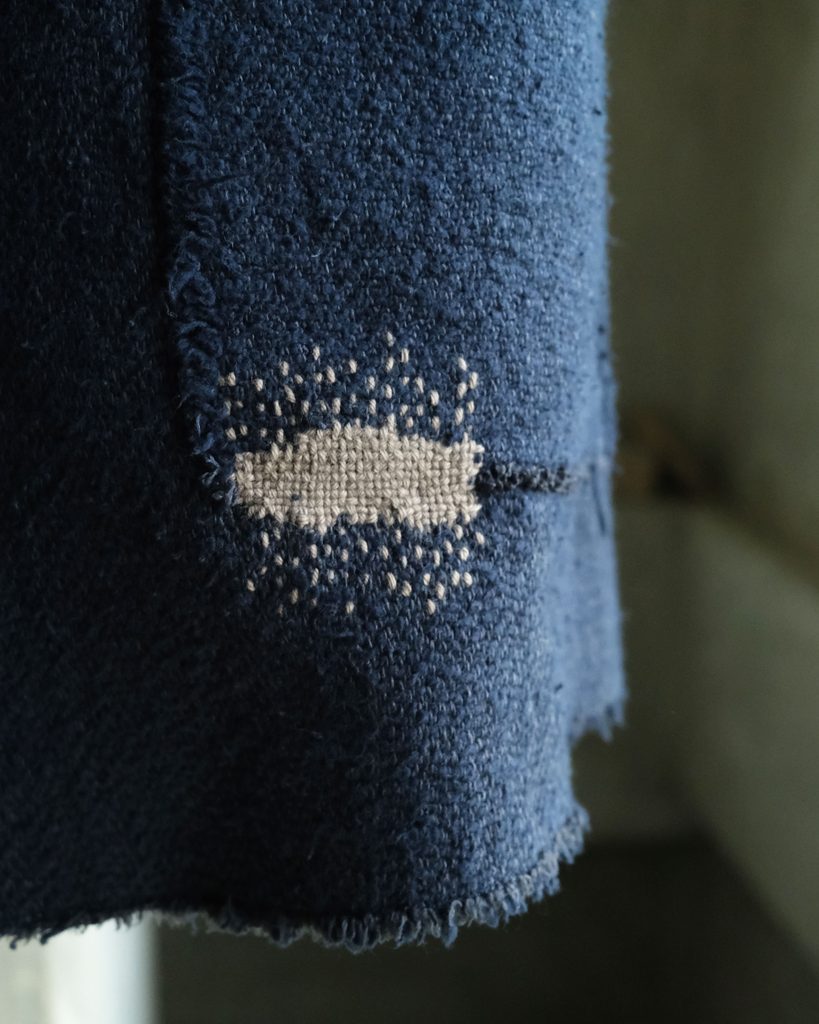
Our first encounter with MITTAN happened after a deep-dive into the Japanese fashion industry. The brand’s array of interesting materials, craftsmanship and designs pulled us closer as deeper research was required to understand its ethos.
The Japanese artisanal brand ‘MITTAN’ was founded by Bunka Fashion College graduate Takeshi Mitani in 2013. Mitani cites ‘It began with a sense that something was wrong’ as part of why MITTAN was created. Whilst we normally put emphasis on the designer, we have—on Mitani’s request—agreed to specifically focus on MITTAN in this interview.
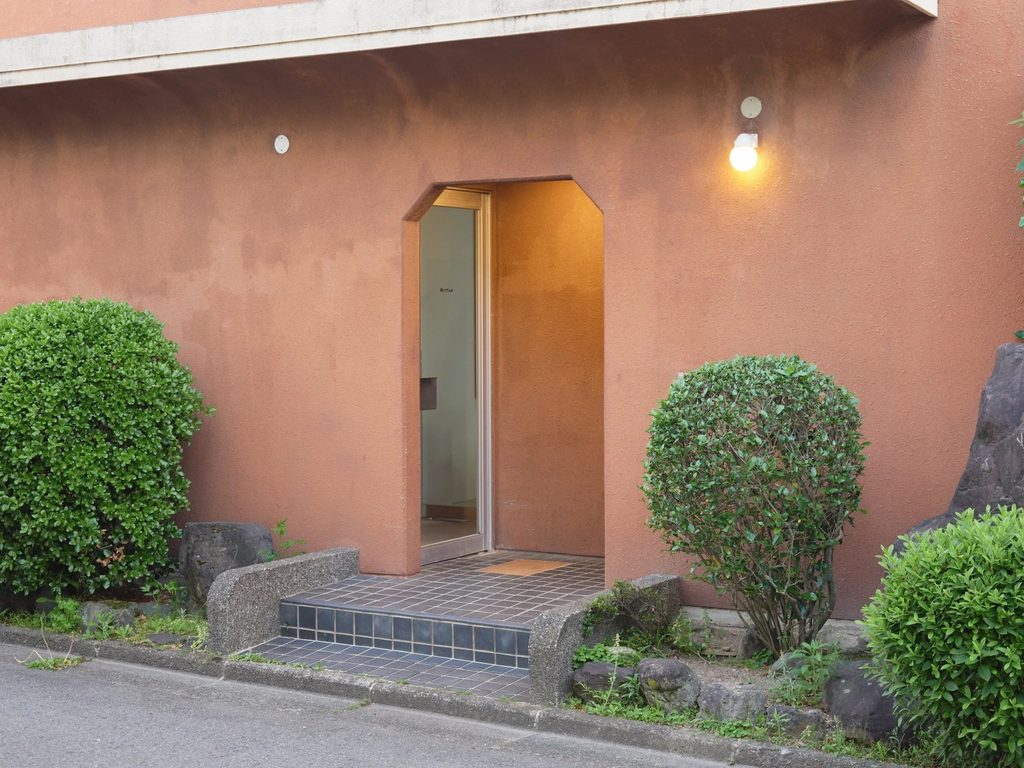
Its ground floor features the repair atelier, which repairs and re-dyes garments.
The upstairs is dedicated to previously owned garments that have been repaired, re-dyed and washed to be ready for resale, alongside samples.
We explore why the brand rarely uses the term ‘sustainability’ when describing its circular philosophy. We also cover its design approach, dyeing and re-dyeing, repairs and buy-backs, and its 2028 targets.
Editor’s note: A few details in our questions, most notably around MITTAN’s dyeing and how makers are credited, turned out to be inaccurate. We’ve opted not to edit the questions to fit Mitani’s answers for full transparency and accountability.
Your brand isn’t really a “fashion” brand but more a brand with a contemporary philosophy that ignores trends. When did you realise that this was the right call for you and that you had to create MITTAN?
MITTAN did not begin with a grand ambition. It began with a sense that something was wrong.
We started in Osaka in 2013, the year the Rana Plaza garment factory collapsed in Bangladesh and more than 1,100 people died. We were entering an industry built on short cycles of consumption and large amounts of waste. In Japan, for example, clothing prices fell to less than half their 1990 level by 2019, while the volume of clothing supplied doubled. Making clothes meant working inside that structure. We came to see the shrinking length of time a garment is worn as one of the causes. If that was the problem, that time had to be lengthened, and unless we worked on that, we saw no reason for us, as a brand, to make new clothes at all.
The clothing industry has long produced more than people need. Keeping existing clothes, including second-hand garments, in circulation could come close to meeting demand on its own.
So what is the point of making new clothes? We have asked that question since the beginning, and we still ask it. MITTAN is our way of continuing to look for an answer, rather than the result of having found one.
MITTAN’s approach to garment making is very unique. Sustainability is often used as part of the marketing, but at MITTAN, it seems to be embedded at its core. Natural dyes, fibres, fabrics and material are all used. Based on this, sustainability and accountability seem to be part of your own identity, would you agree? And what does sustainability mean to you?
We rarely use the word sustainability. We start from a simpler question: how can a garment stay in use? An organic or recycled label alone tells us little about how long a garment will be worn, and the material alone is not enough if the garment is soon thrown away.
For us, keeping clothes in use comes before recycling. We choose things that will last, and materials whose changes with age add to their value rather than take it away. These choices shape the garment from the start.
Accountability, to us, means accurately explaining how we work, including what we have not yet managed to do. That allows people to make an informed choice about the clothes they buy.
What is MITTAN’s approach to design?
Our design starts from how a garment will be worn and kept, rather than from how it looks in a particular season. From the start, we design with repair and re-dyeing in mind: natural fibres without synthetic blends, cotton sewing thread that takes the dye along with the cloth, and reinforcement where a garment comes under the most strain.
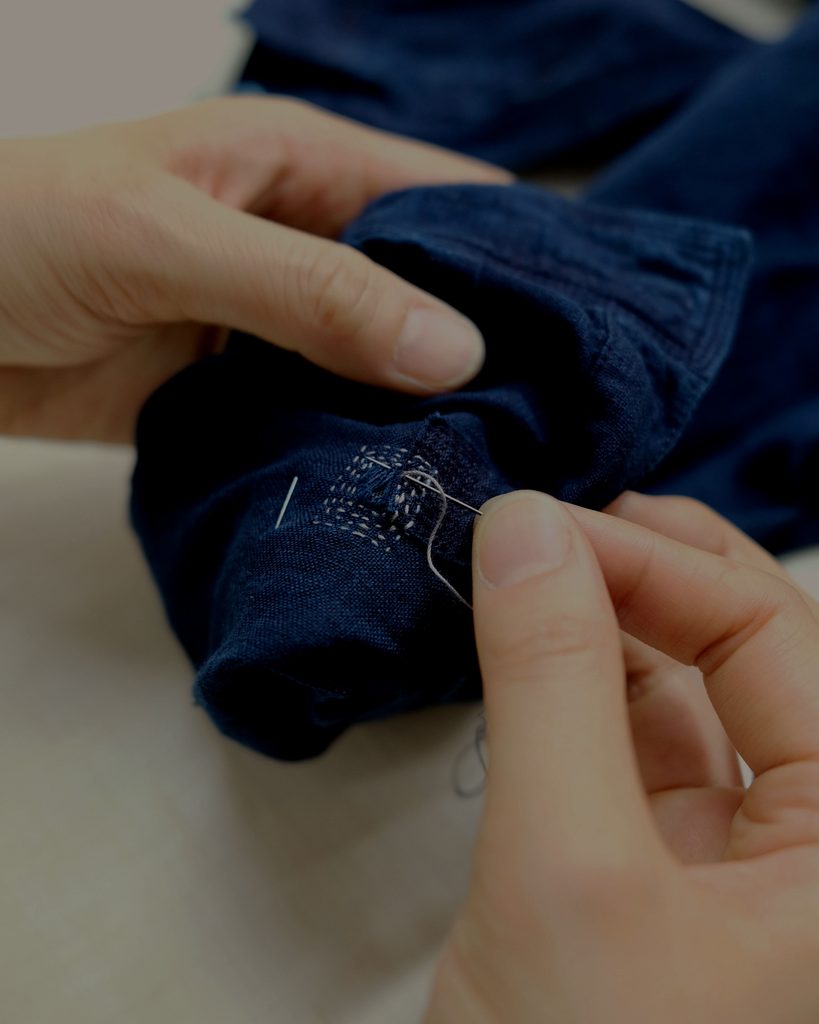
You offer re-dyeing and repair services, which isn’t unique to the brand itself, but it allows for a circular economy and allows garments a second chance. Have you learnt something about yourself as a designer as your products make their way back to you for repair/re-dyeing?
As you say, repair and re-dyeing are not unique to us. For us, though, they are not simply additional services. Keeping clothes in use has been central to our work since 2013. We make around 23,000 garments a year, and last year about 1,000 garments came back to us for repair or re-dyeing.
The garments that come back show us how our designs hold up over time. After a few years of wear, you can see what goes first: cuffs stretch out, side seams split, knees wear thin. Our own sewing team carries out the repairs, so what they learn feeds into later designs.
The garments that come back have also taught us that a garment is not finished when it is bought. When a faded garment is re-dyed in a colour its owner chooses, it often suits that person better than it did at first. We have come to see signs of wear as something that can add to a garment’s value.
Following up on the previous question, how did this idea develop and are there aspects you’d like to improve and or implement into this philosophy?
Repair and re-dyeing were part of the design from the start. Buy-back came from something we noticed later. Even when repair and re-dyeing are available, not everyone stays fond of a garment. Once it has worn through or faded, it tends to be worn less and less, until it is not worn at all, and at some point it may be thrown away. That is why, in 2021, we began buying our garments back.
We buy back MITTAN garments in any condition. We pay 20% of their original retail price in Japan, excluding tax, in cash, then repair or re-dye them as needed and sell them again. The buy-back gives a worn garment value even when its owner no longer wants to wear it. We hope this gives people a reason to bring it back rather than throw it away.
What we want to improve is access. At the moment, repair, re-dyeing and buy-back are only available to people who can send their garments to us in Japan. In the future, we want to be able to collect garments locally in the main regions where our clothes are sold. Whatever condition a garment is in, if we can collect it, we want to buy it back for cash. So please, never throw them away.
On your site, you’ve stated a goal for 2028: to only use materials that meet a certain standard — one that accounts for environmental impact, labour conditions, and animal welfare. What kind of challenges do you expect to face along the way to reaching that goal?
From our 2028 releases onwards, our aim is for at least 99% of the total weight of our production to consist of materials that meet our own standards. This percentage applies to our production as a whole, not to each garment.
Our criteria vary by material. They specify organic cotton, wool from sheep that have not been mulesed, and, as a rule, spun silk made from upcycled raw material. We are still refining them. We have also exchanged written confirmations with all our sewing factories regarding compliance with Japan’s Labour Standards Act. These are written confirmations, not audits.
It is 99% rather than 100% because we have not yet found suitable alternatives for some components: interlinings, stay tape, the stretch yarn in knitwear, zip tape, and sewing thread where strength is needed. These are still synthetic.
Price is a challenge, of course. Changing materials raises costs, and there is a limit to how much of that can go into the retail price. But we will not give up the standards for the sake of price.
The harder question is how far we can really see working conditions. Most of our production is in Japan, so we can visit the factories, but we cannot gather data from the factory floor ourselves, and nothing guarantees that everything is as it should be. We also know where our fabrics are woven and where our garments are sewn. But where sewing factories, dye houses and the farms where the fibres originate are overseas, tracing them with the same accuracy will take more time.
We do want to reduce our impact. But we also think that reducing impact has to become part of a garment’s value, because things that have value are the things people keep.
It is also worth mentioning that being sustainable and selling sustainable products in today’s age often come with a very high price point. But MITTAN’s price point indicates that sustainability should be more accessible, and give people the opportunity to experience real craftsmanship and better materials at a fair price. How do the financial aspects play a part and do you ever worry about making compromises?
Thank you for what you said about our prices. Our clothes are by no means cheap, but we want to show that they can exist at as fair a price as possible.
We have raised prices, but we do not want to rely on raising them again and again. We want people to choose our clothes because they share the thinking behind them. If prices rise too far, we risk relying on the brand’s image to justify them.
We do not want to cut costs at the expense of our material standards or working conditions, by putting more pressure on factories or by moving production to countries where it is cheaper. Instead, we need to make our own work more efficient, and that is where we still have the most to improve. Selling directly is part of this. We have our own shop in Kyoto, and we will open a second one in Kanda, Tokyo, in early 2027. Direct sales change our cost structure and help us limit price increases without putting more pressure on the factories.
Aside from your craftsmanship and transparency, you feature a glossary category on your website. It contains a lot of information regarding different techniques, dyes and materials that MITTAN implements. What made you implement a glossary in the first place? Has it changed how others approach your brand?
A garment is made through the work and knowledge of many people. Between the raw fibre and the finished piece there is spinning, weaving, dyeing and sewing, and each step has its own terms and techniques. Without those words, we felt we could not really explain where a garment comes from.
Each garment has a QR code on its swing tag. It links to information about its materials and, as far as we have been able to trace them, where they came from and where spinning, weaving, dyeing, finishing and sewing took place. The glossary explains the terms used in that information.
We think part of the reason clothes are not looked after is that people no longer know what they are. Clothes used to be much closer to people, rooted in everyday life. Knowing what a garment is, we believe, is what leads people to value it.
On your website, you show appreciation to the people who work on the garments by highlighting their names and linking their social media profiles. How important do you believe it is to showcase the often overlooked human aspects behind the clothes?
Our product pages show where each stage of production took place, with links to the websites of mills and workshops involved in weaving, dyeing, sewing and other stages where they have one. We do not list individual makers’ names.
We believe people are more likely to keep a garment when they know where and how it was made.
It matters for the people we work with as well. We want to keep working with these production partners over time, and showing where the work takes place makes those relationships visible. We believe steady orders, season after season, help the production partners we work with more than a single large order.
What does the production process look like for you and the people you work with? How closely do you work with the artisans who craft the garments? What does working with particular dyeing or sashiko techniques allow you to achieve that a more standard procedure doesn’t?
Most of our production takes place in Japan, and there are very few agents or trading companies between us and the makers, so we mostly deal with them directly. We talk directly with the craftspeople who dye our finished garments, and the same goes for weaving. We visit the mills and workshops as often as we can, even when it takes time and money. Not everything can be solved at a desk. I have been visiting Bishu, the wool-weaving region, for close to twenty years.
We use sashiko and dyeing for practical reasons as well as for how they look. Sashiko began as a way of reinforcing cloth, so we use it where garments come under the most strain. Some of the hand-stitched sashiko on our repaired and resold garments is done at a workshop in Tochigi where people with disabilities work.
With dyeing, it also matters to us that a garment can be dyed again years later. We generally use cotton sewing thread because it takes the dye along with the cloth when a garment is re-dyed, so even the stitches of a repair take on the new colour. Where more strength is needed, such as for attaching buttons, we use thread with a synthetic core or polyester thread. Wool garments are another exception. They are rarely re-dyed, and what we can do for them is limited, but we try to accommodate them as far as we can.
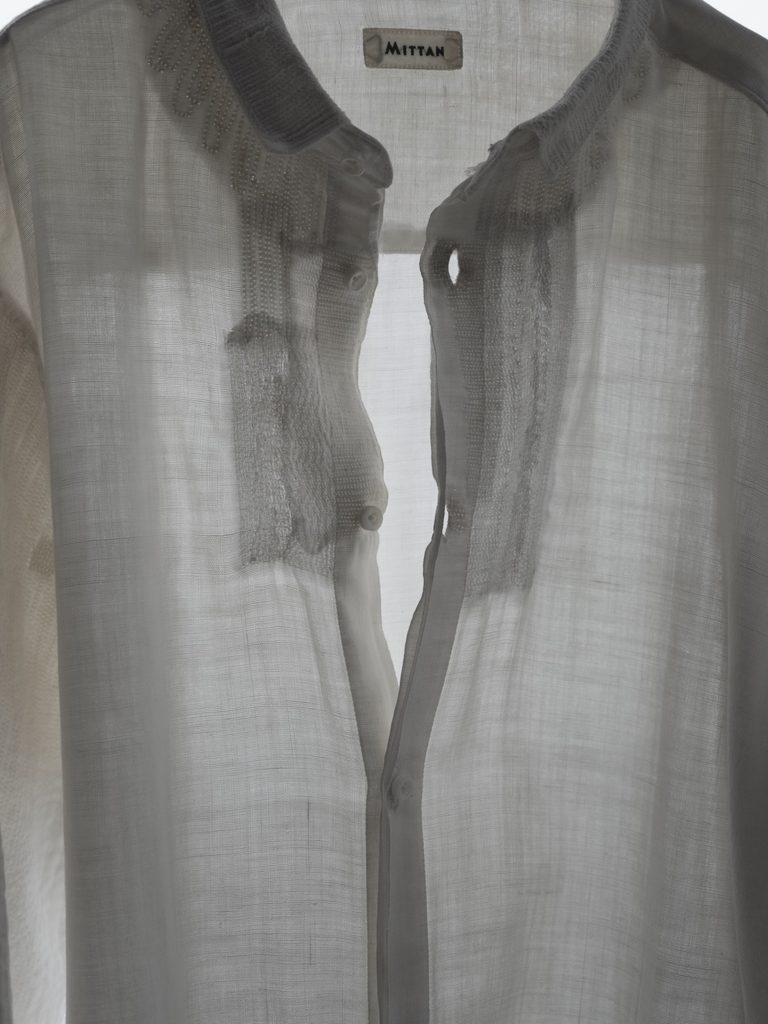
Your brand predominantly uses natural materials, dyes and fabrics. Some of the fabrics and materials you use are imported from China and India (amongst others), are you part of the fabric development or do you source them? What type of requirements do you impose for a fabric to be used?
First, a small correction: our dyes are not all natural, and in fact synthetic dyes make up the larger share. Each dye has its own character. Some natural dyes age beautifully, while some synthetic dyes are more colourfast. We value both.
We develop and order many of our fabrics ourselves, but how we do it varies a great deal. Sometimes we work it out together with a mill, sometimes a mill makes a proposal, and sometimes we do. Only a few are developed from the yarn up. Most of our weaving is done in Japanese textile regions such as Bishu for wool and Enshu for cotton and linen. Some raw materials and yarns come from abroad: hemp, ramie and spun silk, for example, come from China and are woven in Japan. In India, hand-spun, hand-woven cloth is made to our order in West Bengal and in Kutch.
When choosing the main fabric for a garment, we look for three things: natural fibres without synthetic blends, a fabric that improves with wear, and, where possible, a fabric that can be re-dyed. We avoid synthetic blends because they make it much harder to turn the cloth back into fibre and spin it into yarn again at the end of its life. We are also working towards the material standards in our 2028 goal.
If you develop your own textiles, could you guide us through some of the process? If not, do you have plans on developing your own textiles in the future?
There are too many cases to describe a single process. What we do keep in mind is continuity. Rather than using a special finish for one season and moving on, we try to choose work that can carry on for as long as possible. Many designer brands, in Japan and elsewhere, use a particular technique for one season and do not use it again. We would rather keep coming back to the same techniques, season after season.
Recently we have also begun sending cloth left over from cutting to a recycling mill, where it is turned back into fibre and spun again. The recycled fibre keeps the colour of the original cloth. Next, we want to try sorting the scraps by colour before sending them, so that we can get coloured yarn without dyeing it.
Japan has a vast number of famous and long-lasting fashion designers, and there’s a new wave of designers and brands making their way into the West. What are your thoughts on the “new wave” of Japanese brands and designers? What do you think the rest of the world could learn from Japanese design that isn’t already known?
To be honest, I do not feel MITTAN has much in common with Japanese fashion designers, so I am not really in a position to judge the new wave.
What we look at is less fashion design than the way cloth used to be kept in use in Japan. Kimonos were cut from straight lengths of cloth with little waste. They could be taken apart, washed and sewn back together, and when they could no longer be worn, the cloth went on to other uses until it was used up. When cloth was precious, using and repairing it for as long as possible was common sense. Our garments are not all cut in the same way as kimono, but we also want to recover the spirit of that time, when cloth was precious.
Written and edited by Jesper Green
Leave a Reply